India–South Korea Trade Push: UPSC Current Affairs 21 April 2026, Daily GK Update for Competitive Exams
India–South Korea Summit: Context and Background
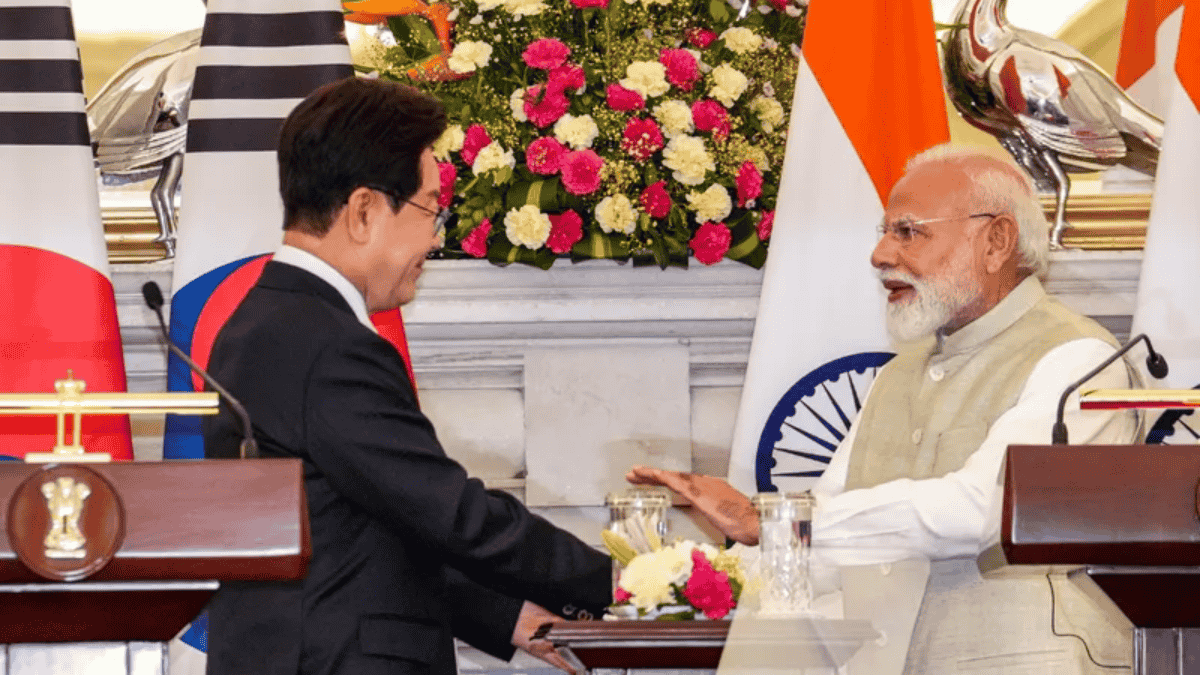
South Korean President Lee Jae-myung paid a state visit to India in April 2026, marking the first state visit by a South Korean president to India in eight years. He held delegation-level talks with Prime Minister Narendra Modi in New Delhi, including a joint press interaction at Hyderabad House. The visit is positioned as a step to upgrade the India–Republic of Korea (ROK) "special strategic partnership" to a more future-oriented, economic-security-driven framework.
India and South Korea already share strong economic and strategic ties, reinforced by the Comprehensive Economic Partnership Agreement (CEPA) that came into force in 2010 and the elevation of ties to a special strategic partnership in 2015. The 2026 summit aims to update and upgrade this framework in light of global supply-chain disruptions and emerging technologies.
Major Announcements and Outcomes of the Visit
Trade Target: Doubling Bilateral Trade by 2030
During the summit, India and South Korea agreed on an ambitious target to nearly double bilateral trade to about 50 billion United States dollars by 2030, from roughly 25–27 billion dollars at present. This target is framed as a joint commitment by both sides to deepen economic integration, diversify supply chains and expand sectoral cooperation.
Key points on the trade target:
Present bilateral trade is around 25–27 billion dollars annually.
New target: approximately 50 billion dollars by 2030, effectively doubling trade.
The emphasis is on making trade more balanced and broad-based across sectors such as shipbuilding, semiconductors, green energy and critical minerals.
MoUs and Framework Agreements
The summit witnessed the signing and exchange of around 15 documented outcomes/MoUs across multiple areas of cooperation. These include both government-to-government frameworks and institutional or business-level understandings.
Broadly, the MoUs and frameworks cover:
Shipbuilding, shipping and maritime logistics
Semiconductors and electronics
Artificial intelligence and digital technologies
Defence production and advanced manufacturing
Energy resource security, clean energy and nuclear energy
Ports and maritime heritage
Small and medium-sized enterprises (SMEs) and industrial cooperation
Trade agreement upgrade processes under CEPA
According to Indian briefings and media reports, a Joint Strategic Vision for Special Strategic Partnership, a comprehensive framework for partnership in shipbuilding and maritime logistics, and a joint statement on sustainability and energy resource security were among the major outcomes.
India–ROK Industrial Cooperation Committee
A key institutional outcome is the launch of the India–ROK Industrial Cooperation Committee, a ministerial-level mechanism to coordinate industrial and economic cooperation.
Its core objectives include:
Facilitating industrial collaboration in sectors like shipbuilding, steel, semiconductors and electric mobility.
Supporting entry and expansion of Korean companies, including SMEs, in the Indian market through regulatory coordination and consultative mechanisms.
Enabling long-term partnerships in industrial infrastructure, port development and supply-chain resilience.
India–Korea Digital Bridge and Economic Security Dialogue
The leaders announced the launch of an India–Korea Digital Bridge focused on cooperation in artificial intelligence, semiconductors, information technology and other emerging technologies. This digital partnership seeks to leverage India’s large talent pool and market with South Korea’s advanced technological capabilities.
In addition, the sides agreed to start an Economic Security Dialogue to coordinate policy on critical technologies, supply-chain security and strategic economic issues. This aligns the partnership with broader Indo-Pacific economic security frameworks and reflects concerns over global disruptions, including conflicts affecting energy and trade routes.
Priority Sectors of Cooperation
Semiconductors and Artificial Intelligence
Semiconductors and AI are at the core of the new partnership framework. India is seeking to build domestic semiconductor manufacturing and design capabilities, while South Korea is a global leader in the chip industry. Cooperation is expected in:
Chip design, fabrication and packaging
Building resilient semiconductor supply chains
Joint research and development in AI applications
Talent development and capacity building in digital technologies
The Digital Bridge initiative is projected as the main platform for these collaborations, with potential involvement of universities, research institutes and private firms on both sides.
Shipbuilding, Ports and Maritime Cooperation
Shipbuilding and maritime logistics are another high-priority area, reflecting South Korea’s established strengths and India’s plans to expand its port infrastructure and blue economy.
Key elements include:
Framework for partnership in shipbuilding, shipping and maritime logistics
Cooperation on next-generation conventional and autonomous maritime and port cranes, and port infrastructure development
Joint work on maritime heritage, sustainability and logistics chains
These initiatives complement India’s efforts to become a hub in Indo-Pacific shipping routes and support its Sagarmala and port-led development programmes.
Energy, Critical Minerals and Green Transition
With global energy markets disrupted and the need for cleaner energy becoming urgent, energy security and green transition form a central pillar of the new India–ROK engagement.
Areas of cooperation include:
Securing critical minerals and energy resources
Nuclear energy collaboration
Clean and renewable energy, including solar and green mobility
Joint initiatives under the International Solar Alliance and the Global Green Growth Institute
South Korea decided to join the Indo-Pacific Oceans Initiative and the International Solar Alliance, while India announced it would join the Global Green Growth Institute headquartered in Korea. This strengthens multilateral climate and sustainability engagement.
Defence, Technology and SMEs
Defence production, advanced manufacturing and the role of SMEs also feature prominently:
Cooperation in defence production and high-end manufacturing linked to shipbuilding and electronics
Support mechanisms and revised MoUs for SMEs to ease regulatory hurdles and promote Korean SMEs’ entry into India
Industrial township concepts and financial forums to facilitate investments and technology transfer
These measures deepen the "from chips to ships, talent to technology, environment to energy" vision articulated by Indian leadership, emphasising a comprehensive economic and technological partnership.
Cultural Diplomacy and People-to-People Ties
Beyond economics and security, cultural and civilisational links were highlighted during the visit. Indian statements recalled the legend of Ayodhya’s Princess Suryaratna—identified with Queen Heo Hwang-ok in Korean tradition—as a symbol of ancient India–Korea ties, providing a civilisational narrative to modern strategic cooperation.
Contemporary soft-power connections such as the popularity of K-pop and Korean dramas among Indian youth were also noted in public remarks, underlining growing people-to-people contact and cultural affinity. The announcement of friendship events and cultural festivals around India–ROK ties fits into this broader people-centric diplomacy.
Key Facts for Quick Revision (UPSC/Competitive Exams)
Country: Republic of Korea (South Korea)
Indian counterpart: Republic of India
Leaders involved: Prime Minister Narendra Modi and President Lee Jae-myung
Occasion: State visit of South Korean President to India (April 2026), first such visit in eight years
Venue of key events: Hyderabad House, New Delhi
Existing framework: Comprehensive Economic Partnership Agreement (CEPA) since 2010; ties elevated to Special Strategic Partnership in 2015
New trade target: Nearly double bilateral trade to around 50 billion United States dollars by 2030, from about 25–27 billion dollars currently
Number of MoU/outcome documents: Around 15 outcomes/MoUs across sectors including shipbuilding, AI, energy and SMEs
New institutional mechanisms:
India–ROK Industrial Cooperation Committee (ministerial-level)
India–Korea Digital Bridge (AI, semiconductors, IT)
Economic Security Dialogue (critical technologies, supply chains)
India–Korea Financial Forum and Industrial Townships (as per Indian statements)
Priority sectors: Semiconductors, AI, shipbuilding, steel, ports, defence production, clean energy, critical minerals, SMEs
Multilateral and green initiatives: South Korea to join Indo-Pacific Oceans Initiative and International Solar Alliance; India to join Global Green Growth Institute
Why this matters for your exam preparation
For UPSC Prelims, factual details such as the new India–South Korea trade target (around 50 billion United States dollars by 2030), the existence of CEPA, and names of new mechanisms like the India–ROK Industrial Cooperation Committee and the India–Korea Digital Bridge are potential MCQ material. Questions can also test membership and roles of bodies like the International Solar Alliance and the Global Green Growth Institute.
For UPSC Mains (GS-II and GS-III), this development is relevant under topics such as India’s bilateral relations, economic diplomacy, Indo-Pacific strategy, technology and energy security. Candidates can use this case to illustrate how India is building "from chips to ships" partnerships to secure supply chains, attract investment, and enhance its role in global value chains.
For Essay and Interview, the visit offers examples of how civilisational narratives (Ayodhya–Queen Heo Hwang-ok legend), soft power (K-pop, K-dramas) and hard economic interests (trade, semiconductors, green energy) are combined in modern diplomacy. It also shows how middle powers like India and South Korea coordinate on economic security amidst shifting global alignments, which can enrich answers on multipolarity, Indo-Pacific and supply-chain resilience.