
Current Affairs April 18, 2026: Project-75I and the India-Germany Submarine Deal | Atharva Examwise Daily GK Update
Amidst increasing geopolitical instability and naval competition in the Indian Ocean Region (IOR), India is poised to take a historic step toward strengthening the security of its maritime borders. Defense Minister Rajnath Singh's official visit to Germany, starting April 21, 2026, is set to be a decisive turning point in this direction. The primary agenda of this visit is to finalize the deal for the construction of six modern conventional submarines under 'Project-75I' (P-75I), estimated to be worth between ₹80,000 crore and ₹99,000 crore. This project will not only bring a revolutionary increase in the Indian Navy's combat lethality but will also serve as a milestone toward achieving the goals of 'Atmanirbhar Bharat' and 'Make in India'.
Project-75I: The Foundation of the Indian Navy's Future Power
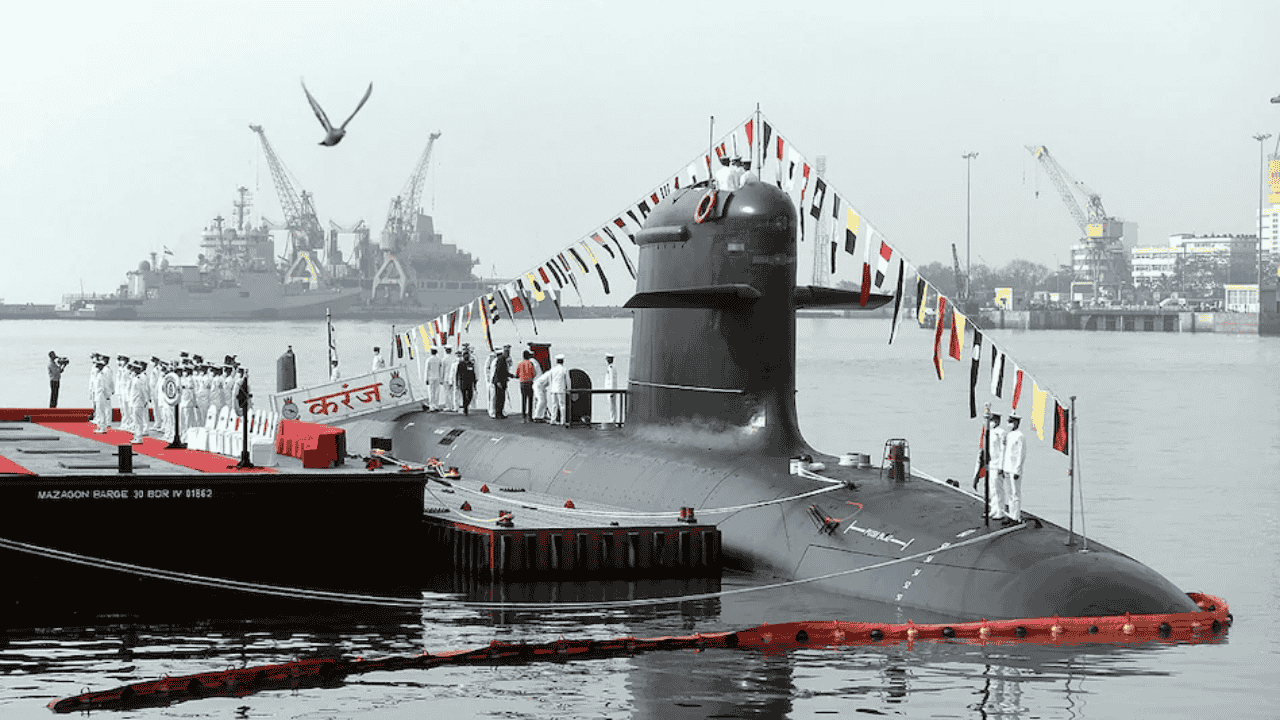
Project-75I is the second phase of the Indian Navy's '30-Year Submarine Construction Plan', which was approved by the Cabinet Committee on Security (CCS) in 1999. The objective of this plan was to build a fleet of 24 modern submarines by 2030. Under Project-75, six Kalvari-class (Scorpene) submarines have already been constructed at Mazagon Dock Shipbuilders Limited (MDL), with the final unit, INS Vagsheer, being commissioned in January 2025. Project-75I is the next and more advanced extension of this sequence.
The six submarines to be built under Project-75I will be of the diesel-electric category, but they will be larger, more lethal, and equipped with more advanced technologies than their predecessors. The most significant feature of this project is the integration of the 'Air Independent Propulsion' (AIP) system, which makes them far more dangerous and stealthy compared to traditional diesel-electric submarines. Germany's leading defense company, 'ThyssenKrupp Marine Systems' (TKMS), will act as the technological partner in this project, collaborating with India's public sector undertaking, MDL, for indigenous construction.
Technical Analysis: Air Independent Propulsion (AIP) and its Combat Potential
The greatest limitation of traditional diesel-electric submarines is their 'endurance'. These submarines require atmospheric oxygen to charge their batteries, for which they must surface or 'snorkel' every 24 to 48 hours. During snorkeling, a submarine becomes highly vulnerable to detection by enemy radar and satellites. AIP technology eliminates this risk.
The AIP system allows a submarine to remain underwater for weeks without using atmospheric oxygen. The Type-214NG design proposed by Germany’s TKMS utilizes a fuel-cell-based AIP system. This technology generates electricity through an electrochemical reaction between hydrogen and oxygen, resulting in no combustion and no noisy moving parts.
Comparative Profile of Submarine Propulsion Systems
| Feature | Conventional Diesel-Electric | AIP-equipped Submarine (P-75I) | Nuclear-Powered (SSN) |
|---|---|---|---|
| Submerged Endurance | 24 - 48 Hours | Approx. 14 Days | Indefinite (Months) |
| Noise Level | Very Low (on battery) | Minimal (due to fuel cells) | Moderate (due to coolant pumps) |
| Snorkeling Requirement | Frequent | Extremely Low | Zero |
| Primary Role | Coastal Defense, Ambush | Long-range Patrol, Sea Control | Strategic Deterrence, Global Reach |
| Cost | Low | Medium | Extremely High |
Submarines equipped with AIP technology can be even quieter than nuclear submarines because the noise from constantly running pumps used to cool nuclear reactors is absent in AIP systems. This silent operation will provide the Indian Navy with a significant strategic edge in shallow and noisy waters like the Arabian Sea and the Bay of Bengal, where detecting enemy aircraft carriers and submarines is already difficult.
Weapon Systems and Combat Capabilities
The submarines built under Project-75I will be known not just for their stealth, but also for their heavy strike capability. These submarines will be capable of performing 'Hunter-Killer' roles as well as conducting precision strikes on land targets.
BrahMos Missile Integration: TKMS has proposed integrating the BrahMos supersonic cruise missile into the Type-214 design. This would place India among an elite group of navies capable of firing long-range supersonic missiles from conventional submarines.
Vertical Launch System (VLS): According to reports, the hull of the Indian version will be larger than standard models (approx. 3,000 tons) to accommodate more missiles and advanced sensors. It is likely to feature a Vertical Launch System, enabling the firing of cruise missiles like Nirbhay.
Heavy Torpedoes and Sensors: These submarines will be equipped with advanced wire-guided torpedoes and modern sonar suites, capable of detecting and destroying enemy movements from long distances.
Multidimensional Missions: They are designed for Anti-Surface Warfare (ASuW), Anti-Submarine Warfare (ASW), Intelligence Gathering (ISR), and Special Forces operations.
Strategic Significance: Power Balance in the Indian Ocean
The rapid implementation of Project-75I has become a strategic imperative for India. The primary reasons are China’s 'String of Pearls' policy and the expansion of Pakistan's naval capabilities.
China is continuously increasing its presence in the Indian Ocean, having established a military base in Djibouti and gained access to ports like Gwadar and Hambantota. Even more concerning is that China is supplying Pakistan with eight 'Hangor-class' (Type-039B) submarines, all of which are equipped with AIP technology. If India does not modernize its submarine fleet in time, a situation could arise where Pakistan's submarine strike capability equals or exceeds India's.
Project-75I will bridge this technological gap. It will give the Indian Navy the ability to not only ensure regional security but also protect Sea Lines of Communication (SLOCs) and effectively implement 'Sea Denial' strategies against enemy naval activities. The blockade of Karachi port during the 1971 war proved how sea control can alter the outcome of a land war. P-75I submarines will make this type of deterrence even more effective in the future.
Strategic Partnership Model (SPM) and Indigenization
Project-75I is the first major project to be implemented under the 'Strategic Partnership Model' of the Defense Acquisition Procedure. This model aims to increase the participation of Indian private and public sectors in defense manufacturing and establish long-term collaborations with foreign Original Equipment Manufacturers (OEMs).
Key Project Partners
| Party | Role | Description |
|---|---|---|
| Indian Navy | User | Determining operational requirements and specifications. |
| Mazagon Dock (MDL) | Indian Strategic Partner | Responsible for construction, integration, and testing of submarines. |
| TKMS (Germany) | Foreign OEM | Providing design authority, Transfer of Technology (ToT), and engineering expertise. |
| DRDO | R&D | Collaboration in the development and future integration of the indigenous AIP module. |
The indigenization requirements under Project-75I are extremely stringent. The first submarine must have at least 45% indigenous content, with a target to increase this to 60% by the sixth and final submarine. This will not only boost India's manufacturing capacity but also create a broad defense industrial ecosystem involving hundreds of MSMEs.
India-Germany Defense Industrial Roadmap 2026
The Defense Minister's visit is not limited to a single submarine deal; it is part of a 'Strategic Reset' between India and Germany. During German Chancellor Friedrich Merz's visit to India in January 2026, both nations signed the 'Defense Industrial Cooperation Roadmap'. This roadmap signals a move beyond a simple buyer-seller relationship toward co-development and co-production.
Germany has traditionally shown hesitation toward defense exports to non-NATO countries, but the war in Ukraine and China's aggressive stance in the Indo-Pacific have shifted Berlin's thinking. Germany now views India as a vital security partner.
Key Points of the Roadmap:
Collaboration in Niche Tech: Both countries will work together in areas such as submarine technology, counter-drone systems, and helicopter obstacle avoidance systems.
Military Exercises: Germany will participate in the multi-national air combat exercise 'Tarang Shakti' and the naval exercise 'MILAN' hosted by India in 2026.
Export Clearances: Germany has committed to accelerating the export clearance process for defense equipment, easing the participation of German companies in the Indian defense sector.
Involvement in IFC-IOR: Germany will station a liaison officer at India's Information Fusion Centre - Indian Ocean Region (IFC-IOR) to enhance maritime domain awareness.
Challenges and the Path Ahead
A project of this scale and complexity faces several challenges that require timely resolution:
Extreme Delays: The concept of P-75I was formed in 1999, but the actual contract is expected in 2026. This 27-year gap has not only increased costs but also put pressure on the Navy's operational readiness.
Cost Escalation: Project costs have nearly doubled from initial estimates, reaching close to ₹1,00,000 crore.
Testing Indigenous AIP: While the land-based testing of the DRDO-developed indigenous AIP has been successful, proving it at sea and integrating it into existing Kalvari-class submarines remains a major technical challenge.
Construction Timeline: Submarine construction is a complex process taking 7-10 years. The first delivery is likely around 2032-33, meaning India must carefully manage its aging fleet until then.
Despite these challenges, P-75I is a game-changer for India. It will not only establish the Indian Navy as an invisible hunter but also provide the design and construction skills necessary for future fully indigenous projects like 'Project-76'.
Significance for UPSC and Competitive Exams
The Project-75I and India-Germany submarine deal are extremely important for various papers of the UPSC General Studies (GS):
GS Paper-II (International Relations): 25 years of India-Germany Strategic Partnership, changing geopolitics in the Indo-Pacific, and defense diplomacy. Shift in Germany's defense export policy and its global implications.
GS Paper-III (Science and Technology): Working of Air Independent Propulsion (AIP) technology, Fuel cells vs. Stirling engines, SONAR, and communication technologies (VLF/ELF). Impact of indigenization and 'Atmanirbhar Bharat' in the defense sector.
GS Paper-III (Internal and Maritime Security): Maritime security challenges in the Indian Ocean, China’s 'String of Pearls' and India’s response, strategies of Sea Control vs. Sea Denial.
Prelims: Direct questions can be asked regarding 'Make in India', the 'Strategic Partnership Model', various versions of the BrahMos missile, and the different submarine classes of the Indian Navy (Kalvari, Shishumar, Sindhughosh).
[Related Article: India's 30-Year Submarine Construction Program - Atharva Examwise]
This project is a testament to the fact that India no longer wants to be just a buyer of defense equipment but is moving toward becoming a manufacturer and exporter. As a serious aspirant, you should understand not just the financial aspects of this deal, but also the technical depth and strategic foresight behind it.
Atharva Examwise - Your Success, Our Resolve.