
In late June and early July 2026, Western and Central Europe experienced an extraordinary and catastrophic early-summer heatwave, shattering long-standing temperature records and prompting emergency red alerts across multiple nations. This severe meteorological crisis, which pushed regional measurements in France’s wine-producing zones like Bordeaux to $41.9^\circ\text{C}$ and peak regional temperatures to $44.3^\circ\text{C}$, has resulted in dozens of heat-related fatalities, extensive ecological strain, and disruptions to the continental power grid.
The immediate catalyst for this extreme weather event is a large-scale atmospheric phenomenon known as an "Omega Block". Understanding the mechanics of atmospheric blockings, their interaction with the global jet stream, and their thermodynamic consequences is critical for serious competitive exam aspirants, particularly in the context of physical geography, disaster management, and environmental policy.
Defining the Omega Block and Its Structural Components
An atmospheric "block" refers to a large-scale, nearly stationary pressure pattern in the mid-latitudes that effectively stalls or redirects the standard west-to-east migration of cyclones and weather fronts. When a blocking pattern becomes established, the regional atmosphere experiences prolonged, stagnant weather conditions.
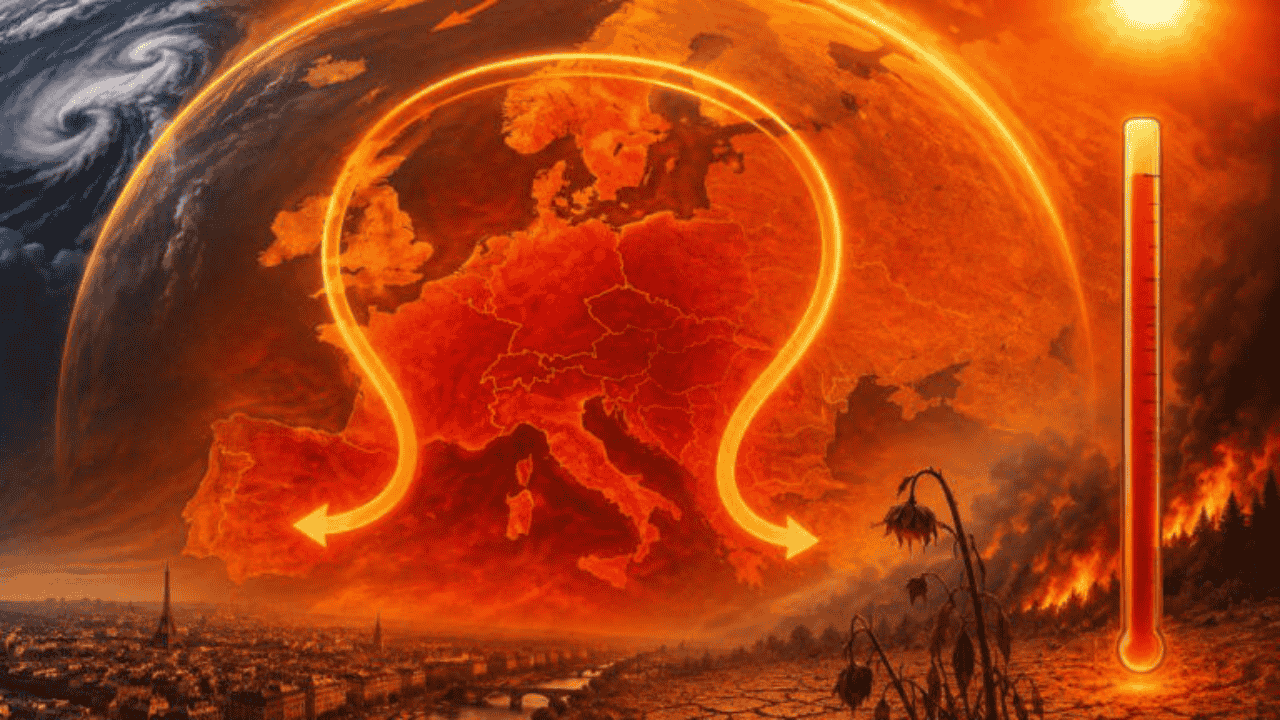
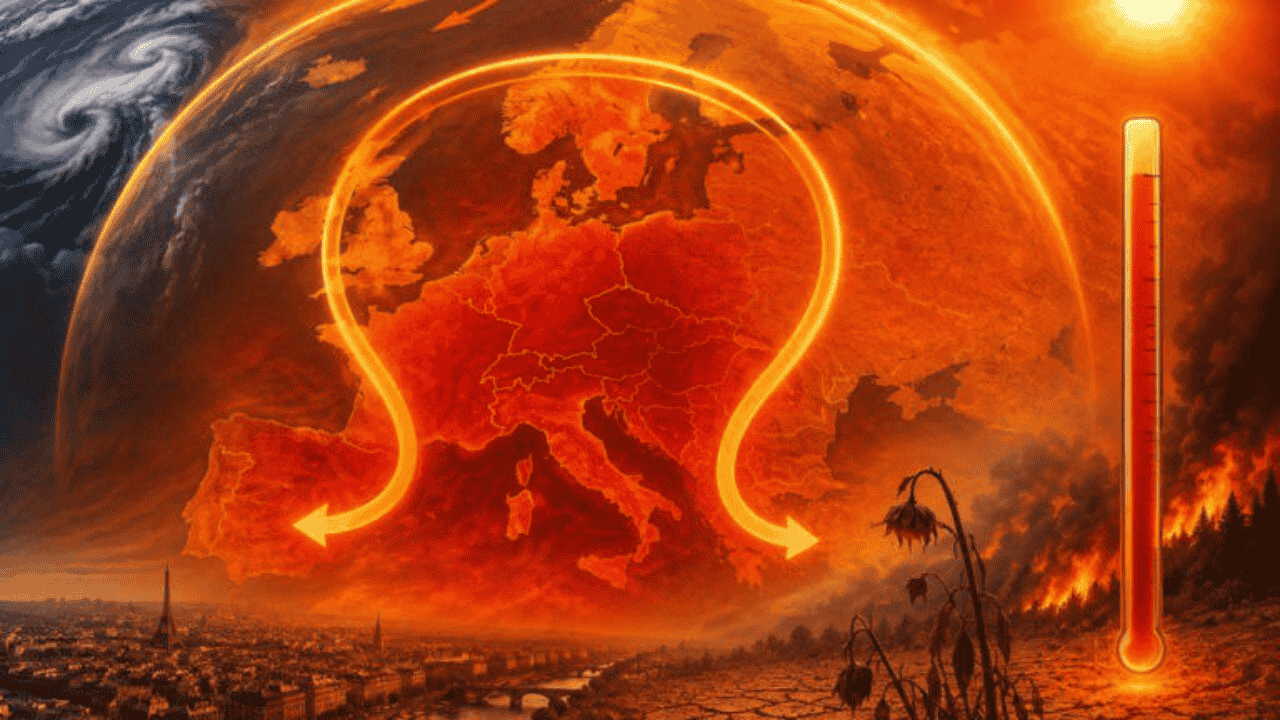
An Omega Block is a specific type of blocking configuration named after its striking resemblance to the uppercase Greek letter Omega ($\Omega$) on upper-air geopotential height charts. It is structurally defined by three interacting pressure cells arranged in a west-east direction:
The Central Anticyclone (High-Pressure Ridge): A massive, slow-moving or stationary high-pressure system positioned at the core of the block. It rotates clockwise in the Northern Hemisphere, encouraging sinking air and clear skies.
The Flanking Cyclones (Cut-off Lows): Two distinct, cold-core low-pressure systems flanking the central high-pressure ridge to its west and east. These low-pressure systems rotate anticlockwise in the Northern Hemisphere.
During the 2026 European heatwave, this configuration was illustrated by a stationary high-pressure ridge locked over France and Spain, sandwiched between a cut-off low off the Portuguese coast and another low-pressure system over Central Europe. This spatial arrangement creates a physical "traffic jam" in the atmosphere. Under normal conditions, the jet stream flows in a relatively straight path from west to east, dragging weather systems along with it. However, when an Omega Block forms, the jet stream is forced to meander sharply northward over the central high-pressure ridge, bypassing it and leaving the entire three-cell system stationary for days or even weeks.
The "Heat Pump" Mechanism
The severe heat observed during an Omega Block is often intensified by a secondary dynamic known as the "heat pump" effect. In the European context, the western flanking low-pressure system off the Portuguese coast acts as an atmospheric vacuum. Because cyclones rotate anticlockwise, this low-pressure cell draws hot, dry air masses directly from the Sahara Desert in North Africa and channels them northward. This intense advection of desert air is pumped straight into the stagnant central high-pressure ridge over Western Europe, where it is trapped and continuously compressed.
Jet Stream Behavior and Rossby Wave Dynamics
To analyze how an Omega Block develops, meteorologists study the behavior of upper-tropospheric jet streams—high-velocity geostrophic winds that circulate from west to east. The mid-latitudes are primarily influenced by two wind bands:
The Polar Front Jet (PFJ): Located around $60^\circ\text{ N/S}$ latitude at lower elevations ($6\text{ to }9\text{ km}$).
The Subtropical Jet (STJ): Operating near $30^\circ\text{ N/S}$ latitude at higher elevations ($10\text{ to }16\text{ km}$).
The strength and stability of these jet streams are governed by the temperature gradient between the polar and tropical regions. Under standard conditions, a strong polar vortex keeps the polar jet stream fast and tightly bound around the high latitudes, maintaining strong westerly winds. However, when the temperature difference between the equator and the poles decreases, the wind velocity of the jet stream falls.
According to geostrophic wind physics, a reduction in wind speed decreases the Coriolis deflection. This loss of momentum causes the jet stream to buckle and meander in highly pronounced, wave-like trajectories called Rossby Waves. When these waves become exceptionally amplified and stationary, they pinch off from the main flow. This process isolates the flanking low-pressure troughs and the central high-pressure ridge, resulting in a blocked weather pattern.
Thermodynamics of the Heat Dome and Adiabatic Heating
While the Omega Block describes the structural wind and pressure layout in the upper atmosphere, a Heat Dome refers to the physical trapping and progressive heating of the air mass near the surface. Within the central anticyclone of the Omega Block, the primary physical mechanism driving extreme temperatures is atmospheric subsidence (sinking air).
1. The Physics of Adiabatic Compression
As winds circulate clockwise within the upper-level anticyclone, they are forced to sink toward the Earth's surface. As this air descends, it moves into layers of higher atmospheric density, meaning the weight of the air column above it increases. This increase in environmental pressure compresses the volume of the descending air mass.
According to the classical first law of thermodynamics:
$$dQ = dU + dW$$
Where $dQ$ represents the heat exchanged, $dU$ is the change in internal energy, and $dW$ is the work done. Because this large-scale subsidence occurs rapidly, there is virtually no heat exchange with the surrounding atmosphere ($dQ = 0$), making it an adiabatic process. Consequently, the mechanical work done on the air mass during compression ($dW$) is converted entirely into internal energy ($dU$), causing the temperature of the descending air column to rise.
This compressional heating occurs at the dry adiabatic lapse rate ($\Gamma_d$):
$$\Gamma_d \approx 1^\circ\text{C} \text{ for every } 100 \text{ meters of descent}$$
2. The Feedback Loop of Stagnant Surface Air
This descending, warming column of air exerts massive downward pressure on the surface, acting like an atmospheric lid on a pot. This lid suppresses vertical convection and prevents the rising of warm, moist air, which completely blocks cloud formation.
In the complete absence of cloud cover, uninterrupted solar radiation strikes the ground directly with maximum intensity. This dries out the soil and vegetation. As the ground loses its moisture, the landscape loses its capacity for evaporative cooling (latent heat flux). Instead, solar energy is converted entirely into sensible heat, warming the surface air further and creating a self-reinforcing loop that drives temperatures higher day after day.
Meteorological Comparison of Blocking Patterns
To contextualize the Omega Block within physical geography, it is useful to compare it against other prominent blocking configurations recognized by meteorologists.
| Blocking Type | Structural Setup | Jet Stream Movement | Typical Regional Weather Impacts |
|---|---|---|---|
Omega Block [cite: 7, 9] | A central high-pressure anticyclone flanked by two isolated, cut-off low-pressure cyclones to its west and east. | The jet stream buckles north and south in a highly curved path resembling the letter $\Omega$. | Extreme heat, dry soils, and poor air quality under the central high; heavy, slow-moving storms and cooler-than-normal rain on the flanks. |
Rex Block (Dipole Block) [cite: 7, 8] | An isolated high-pressure system positioned directly poleward (north in the Northern Hemisphere) of an isolated low-pressure system. | The jet stream splits into northern and southern branches around the closed pressure systems, or follows a reflected "S" pattern. | Extreme latitudinal contrast; warm, stable weather in the north, while southern latitudes suffer from persistent rain and cool temperatures. |
Amplified Ridge [cite: 7] | A high-pressure ridge stretching far north, flanked by deep troughs extending south, without fully isolating into cut-off low centers. | The jet stream exhibits a strong, stationary north-to-south (meridional) flow pattern. | Highly stable, prolonged weather conditions; frequently triggers severe winter cold snaps or persistent, stagnant summer heatwaves. |
Climate Change as a Force Multiplier for Atmospheric Blocks
Atmospheric blocking events and heat domes are naturally occurring weather patterns that have historically developed across mid-latitudes. However, climate scientists emphasize that anthropogenic global warming acts as a critical force multiplier, amplifying the severity, duration, and frequency of these blocking configurations.
Arctic Amplification and Jet Stream Meandering
The polar regions are warming at more than twice the global average rate—a phenomenon known as Arctic Amplification. This rapid warming is driven primarily by the ice-albedo feedback: as bright white sea ice melts, it exposes darker ocean water, which absorbs solar radiation instead of reflecting it. This high-latitude warming reduces the temperature gradient between the Arctic and the equator.
A weakened temperature gradient reduces the pressure difference across the mid-latitudes, slowing down the geostrophic winds of the polar jet stream. A slower, weaker jet stream is far more susceptible to buckling into high-amplitude Rossby waves, making stationary blocking patterns like Omega Blocks more frequent and harder to break down.
Higher Thermal Baselines and "Climate Whiplash"
Global greenhouse gas emissions have raised the baseline planetary temperature by approximately $1.3^\circ\text{C}$ above pre-industrial levels. Consequently, any modern atmospheric blocking event operates on a much higher thermal starting point. A blocking pattern that might have produced warm, sunny conditions in past decades now drives temperatures to extreme, life-threatening peaks.
Furthermore, because these blocks feature deep low-pressure systems adjacent to intense heat domes, regions on the boundaries can experience "climate whiplash"—sudden, destructive transitions from record-breaking droughts and wildfires under the high-pressure system to severe flooding and convective storms on the edges.
For a closer look at global climate policy and how emissions are tracked internationally, aspirants can read the Climate Change Performance Index (CCPI) 2026, which provides critical data on emissions and policy frameworks.
Detailed Chronology and Data: The 2026 European Heatwave
The early-summer heatwave of June and July 2026 served as a vivid demonstration of the destructive potential of an Omega Block operating in a warmed climate.
Peak Meteorological Data Across European Countries
France: On June 24, 2026, France recorded its hottest national day on record, beating the peak average temperature set just the previous day with a nationwide average indicator of $30.0^\circ\text{C}$ (surpassing records from July 2019 and August 2003). Local measurements in the southern wine regions reached $44.3^\circ\text{C}$, and at least 18 direct heat-related deaths and 40 accidental drownings were reported.
Spain: Spain registered its hottest June days on record on June 23 and 24, 2026, with multiple municipalities reporting temperatures above $40^\circ\text{C}$. In Andalusia, temperatures reached $44.0^\circ\text{C}$, while the town of Andújar reported a peak of $45.0^\circ\text{C}$ under the core of the heat dome.
United Kingdom: The UK Met Office reported a provisional daily maximum temperature of $36.1^\circ\text{C}$ at Gosport on June 24, breaking previous monthly averages just weeks after similar temperature records were shattered in May.
Germany & Switzerland: Red alerts were issued across major urban areas including Bonn, Frankfurt, Cologne, Geneva, Basel, and Zurich as the stagnant air mass prevented overnight cooling.
Infrastructure and Social Vulnerabilities
This crisis highlighted a significant mismatch between Europe's climate history and its current reality. Most European residential buildings were historically designed for cold-weather heat retention, utilizing thick insulating walls that trap warm air during intense summers.
Furthermore, domestic air conditioning is rare in Western Europe, and exceptionally long summer daylight hours provide very little night-time window for buildings and the human body to cool down. This lack of nocturnal recovery—often referred to as a "tropical night" when minimum temperatures do not fall below $20^\circ\text{C}$—creates severe cardiovascular strain, particularly for Europe's rapidly aging population.
Global Teleconnections and Implications for India
While the 2026 Omega Block occurred over Europe, changes in mid-latitude wind patterns have strong global teleconnections that can directly impact India's climate:
1. Monsoonal Disruptions and Rainfall Variability
The Indian Summer Monsoon is highly dependent on the seasonal transition and behavior of global jet streams, particularly the retreat of the subtropical westerly jet northward of the Himalayas. When the mid-latitude flow becomes highly meandering and blocked over Europe and Central Asia, it can stall the progression of these jet streams.
This stalling can lead to:
A delayed or weakened monsoonal onset over India.
An increased probability of below-normal monsoon rainfall, especially during the crucial late-monsoon months of August and September.
A higher frequency of prolonged dry spells, affecting agricultural productivity and water storage.
This agricultural vulnerability is especially critical for traditional systems like shifting or Jhum cultivation, where planting cycles are timed to the precise arrival of the monsoon. Candidates can explore the cultural and ecological dimensions of these cycles in the Lebang Boomani Dance of Tripura.
2. Exacerbating India's Water Emergency
The combination of warming temperatures and unpredictable rainfall patterns has pushed many global regions into what the United Nations describes as "global water bankruptcy". India is at the epicenter of this crisis, experiencing severe groundwater depletion and water stress across its northern and western states. Prolonged heatwaves (with temperatures regularly exceeding $45^\circ\text{C}$ in major urban centers like Delhi) accelerate evaporation from lakes and reservoirs, pushing cities closer to "Day Zero" scenarios.
To understand the broader policy frameworks and structural causes of this crisis, refer to the Global Water Bankruptcy Report.
Key Exam-Relevant Facts and Data
For aspirants preparing for competitive examinations, the following consolidated dataset provides high-yield facts for quick revision:
Atmospheric Blocking Definition: Large-scale, stationary geopotential pressure structures in the mid-latitudes that disrupt the standard westerly flow of cyclones.
Omega Block Characteristics: Named after the uppercase Greek letter ($\Omega$). It features a central high-pressure anticyclone (clockwise rotation) flanked by two cut-off low-pressure cyclones (anticlockwise rotation).
Primary Thermodynamic Principle: Adiabatic compressional heating ($dQ=0$) in descending air currents, raising temperatures by approximately $1^\circ\text{C}$ per $100\text{ meters}$ of descent.
La Niña and El Niño Influences: Global climate oscillations interact with mid-latitude wave patterns, altering the frequency and intensity of stationary atmospheric blocks.
Europe's Warming Rate: Europe is currently the fastest-warming continent on Earth, warming at more than twice the global average rate, which exacerbates the impact of blocking events.
Disaster Management Scope: Extreme heat is classified as a multi-sectoral disaster, simultaneously straining healthcare, electrical grids, urban transport, agriculture, and water safety.
Urban Heat Island (UHI) Effect: Trapped heat inside concrete urban environments prevents nocturnal cooling, turning stagnant air zones into severe localized health hazards.
Why this matters for your exam preparation
For candidates preparing for the UPSC Civil Services Examination and other state-level competitive exams, the study of the Omega Block and atmospheric blocking dynamics is highly relevant across several syllabus areas:
1. General Studies Paper I (Physical Geography)
Core Concepts: Important geophysical phenomena, planetary winds, jet streams, Rossby waves, and the thermodynamic properties of high-pressure and low-pressure systems.
Climatic Changes: Factors affecting mid-latitude climates, Arctic amplification, the albedo effect, and the spatial distribution of extreme weather events.
2. General Studies Paper III (Environment, Disaster Management, and Agriculture)
Climate Change Impacts: The role of anthropogenic emissions in amplifying natural weather anomalies.
Disaster Preparedness: Policy responses to extreme heatwaves, such as the formulation of Heat Action Plans (HAPs), urban cooling strategies (including cool roofs, green corridors, and water-sensitive urban design), and the management of water resources during droughts.
Agricultural Resilience: Developing climate-resilient crop varieties and adjusting agricultural practices to cope with jet-stream-induced monsoon variability.
3. Essay and Strategy Linkages
This subject provides excellent material for illustrating the real-world consequences of climate change in general essay papers. Concepts such as "global water bankruptcy", "global weirding", and "climate whiplash" can be paired with structural case studies—like the comparison between European and Indian heat resilience—to write highly analytical, high-scoring answers.
Practice UPSC Questions for Aspirants
Prelims Practice Question
Question: Consider the following statements regarding the "Omega Block" weather pattern:
It is characterized by a central low-pressure system trapped between two flanking high-pressure systems.
Under normal conditions, the jet stream carries weather systems from west to east, but an Omega Block disrupts this flow, causing the pressure systems to become stationary.
Air descending beneath the central system of an Omega Block undergoes adiabatic expansion, which cools the air mass and suppresses cloud formation.
Which of the statements given above is/are correct?
(a) 1 and 2 only
(b) 2 only
(c) 2 and 3 only
(d) 1, 2, and 3
Answer: (b) 2 only
Explanation: Statement 1 is incorrect because an Omega Block consists of a central high-pressure system trapped between two flanking low-pressure systems. Statement 2 is correct because the block disrupts the normal westerly flow, forcing the jet stream to meander sharply and isolating the weather systems. Statement 3 is incorrect because descending air within a high-pressure system undergoes adiabatic compression (not expansion), which raises its internal energy and heats the air column.
Mains Practice Question
Question: "While atmospheric blocking patterns like the Omega Block are naturally occurring phenomena, global climate change acts as a critical force multiplier that intensifies their consequences." Discuss the meteorological mechanisms of an Omega Block and evaluate its implications for mid-latitude infrastructure and global agricultural patterns.