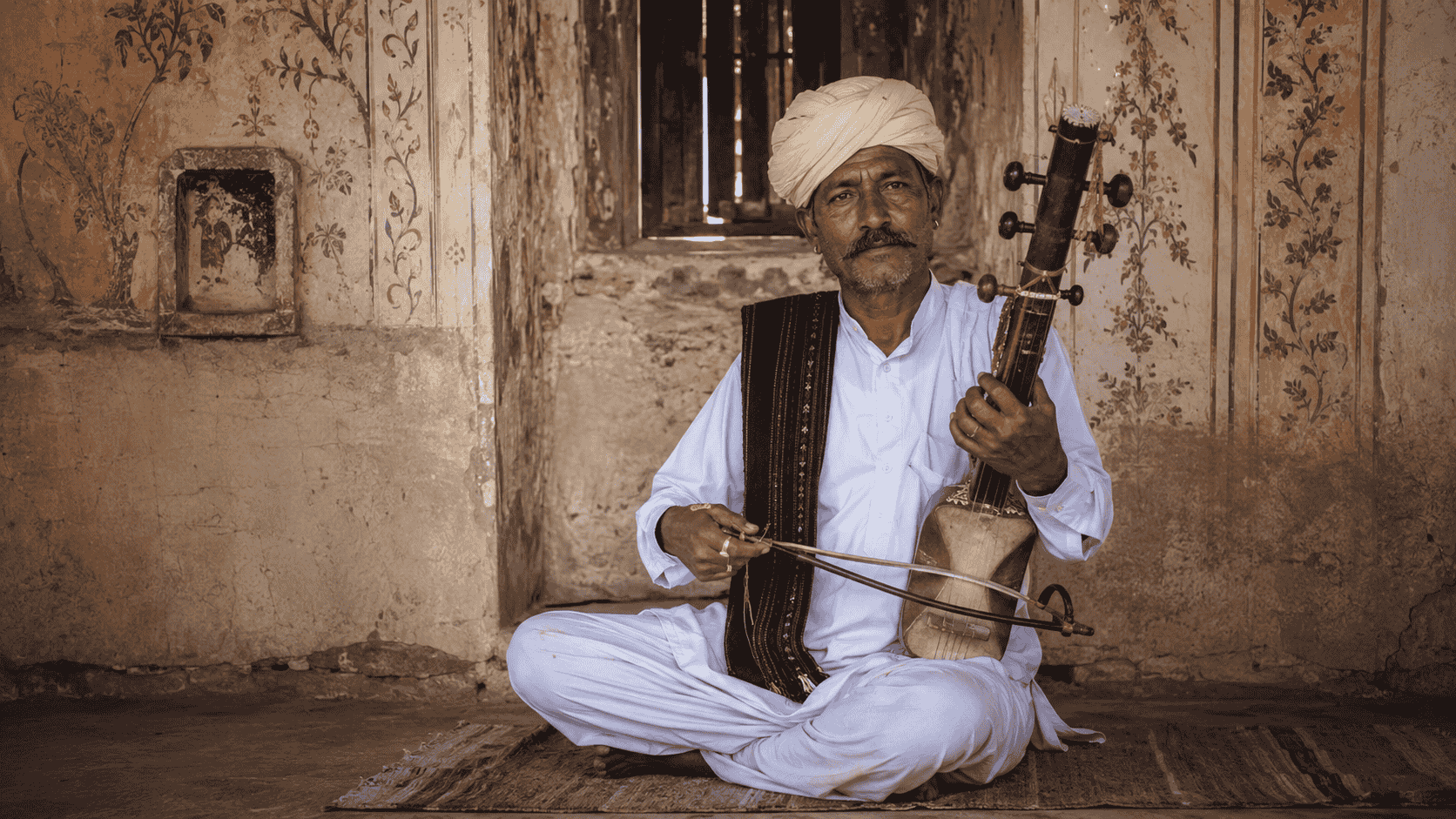
From the perspective of the Union Public Service Commission (UPSC) and other state-level administrative examinations, India's rich Intangible Cultural Heritage is a highly crucial segment. In this context, 'Kamaycha' (or Kamaicha), a traditional musical instrument from the western desert region of Rajasthan, is particularly relevant for the Art and Culture syllabus.
The Kamaycha is not merely a musical instrument; it is a living symbol and cultural bearer of the centuries-old Manganiyar musical tradition of the Thar Desert. In this Daily GK Update issue of June 13, 2026, a multi-dimensional and exam-oriented analysis of the structural specificities of the Kamaycha, its socio-cultural fabric, and the contemporary existential crises looming over it is presented below.
Classification and Structural Design of the Kamaycha
In the Indian classical music tradition, the classification of musical instruments is done according to the historical rules laid down in the Natyashastra. Under this, the Kamaycha is categorized under the 'Tat Vadya' (stringed or chordophone instruments) category. Its construction and sound production techniques are highly complex and entirely based on local organic resources.
Major Physical Components of the Kamaycha and Their Functions
| Physical Component | Material Used | Acoustic & Structural Function | Local Name / Distinctive Features |
|---|---|---|---|
| Main Body (Resonator Body) | Mango or Sheesham wood | Provides the foundational base to the instrument and generates resonance. | Carved entirely out of a single piece of wood. |
| Tabli (Belly / Soundboard) | Goat skin (parchment) | Covers the hollow resonator section and amplifies sound vibrations. | It is completely round and approximately 1.5 feet wide. |
| Primary Strings | Goat gut (Gut strings) | Generates the primary melody and Raga. | Locally known as 'Roda' and 'Joda'; they are 3 in number. |
| Sympathetic Strings | Steel (metallic wires) | Indirectly resonates (echoes) in tandem with the vibrations of the primary strings. | Locally called 'Zhara'; they generally range from 12 to 14 in number. |
| Biz / Bridge | Sheesham wood | Transfers the vibrations of the strings directly to the goat-skin tabli. | Locally known as 'Ghori'. |
| Gaj (Bow) | Khejri or Sheesham wood and horsehair | Generates sound by creating friction across the strings. | Small bells (ghungroos) are tied to the bow to add a rhythmic chime. |
Comparative Analysis: Kamaycha vs. Sarangi
Although the Kamaycha appears similar to the Sarangi in appearance and playing style, there are significant technical and structural differences between the two:
While the tabli (belly) of the Sarangi is elongated and rectangular, the tabli of the Kamaycha is entirely round and much wider (nearly 1.5 feet).
Furthermore, the resonance of the Kamaycha is exceptionally deep, somber, and soulful, providing a unique melodic depth that mirrors the vast emptiness and silence of the Thar Desert.
The Manganiyar Community and the Cultural Ecosystem of the Kamaycha
The existence of the Kamaycha is historically intertwined with the 'Manganiyar' community of western Rajasthan (primarily Jaisalmer and Barmer districts). An analysis of the socio-cultural fabric of the Manganiyar community is highly vital for the examination:
Cultural Syncretism: The Manganiyars are fundamentally a Muslim community that has for centuries performed music for their Hindu patrons (locally known as 'Jajmans'). Their singing and instrumentation present a unique synthesis of Sufi mysticism alongside Hindu bhajans, devotional songs, and folklore.
Connection with Nath-panthi Sadhus: Apart from the Manganiyar community, the Nath-panthi sadhus of Rajasthan also extensively utilize the Kamaycha. These ascetics specifically sing the legendary tales of King Bharthari and Gopichand to the melodious and deep tunes of the Kamaycha.
Traditional Playing Style: Historically, Manganiyar players did not use the dholak or other percussion instruments. They sang solo while playing the Kamaycha, generating both the melody and a rapid rhythm simultaneously through the masterful synchronization of the bow (gaj) and primary strings.
Key Exam-Relevant Facts
Tat Vadya Classification: The Kamaycha is an ancient bowed string instrument classified as a 'Tat Vadya' under the Indian system of musical instrument classification.
String Configuration: It features a total of 17 strings, comprising 3 primary strings made of goat gut and 14 sympathetic strings made of steel.
Geographical Distribution: It is predominantly popular in the Jaisalmer and Barmer districts of western Rajasthan.
Cultural Affiliation: It is exclusively played by the Manganiyar community and Nath-panthi sadhus.
Padma Shri Honor: Ustad Sakar Khan Manganiyar was conferred with the 'Padma Shri' in the year 2012 for his unparalleled mastery over this instrument.
Prominent Exponents and the Global Representation of the Kamaycha
A few extraordinary artists have played an unparalleled role in taking the Kamaycha out of the courtyards of desert villages onto international stages:
Padma Shri Ustad Sakar Khan Manganiyar (1938–2013)
Born in Hamira village of Jaisalmer, Ustad Sakar Khan is considered the greatest exponent of this instrument of all time. Alongside renowned folklorist Komal Kothari, he worked extensively to revive this art form. Sakar Khan introduced crucial structural modifications to the traditional Kamaycha, increasing the number of sympathetic strings to refine the subtlety and depth of its sound.
For his outstanding contribution to the arts, he was honored with the 'Tulsi Samman' in 1990, the 'Sangeet Natak Akademi Award' in 1991, and the country's fourth-highest civilian honor, the 'Padma Shri', in 2012. His renditions of Raga Bhairavi and Raga Kalyani are preserved in the world-famous Smithsonian Folkways archive in Washington.
Other Historical and Contemporary Exponents
Historically, masters like Chanan Khan Manganiyar, Hakam Khan Manganiyar, and Hakim Khan Manganiyar kept this art alive. In the current generation, Ustad Sakar Khan’s sons—Dare Khan, Firoz Khan, and Ghewar Khan—are carrying this legacy forward.
Government Recognition
In the year 2020, the Government of India released a special commemorative postage stamp featuring the Kamaycha, validating its immense significance as a part of national heritage.
Existential Crisis and Modern Conservation Challenges
Despite receiving global acclaim, the tradition of playing the Kamaycha is currently facing a severe existential crisis. An analysis of the data highlights the grim nature of this decline:
Numerical Decline: According to research, there were 247 active Kamaycha players in western Rajasthan in 1993, all belonging to the Manganiyar community. By 2025/2026, this number has dwindled to a negligible few.
Luthier (Maker) Crisis and Economic Costs: Constructing a Kamaycha is highly expensive and labor-intensive. The availability of this instrument in the market is virtually non-existent because only a handful of skilled artisans remain. Due to a lack of financial resources, young artists are unable to afford it.
Complex Technical Training: Learning this instrument demands immense patience and decades of rigorous practice. Producing the correct note on a fretless fingerboard using only the touch of fingernails is an incredibly daunting task.
The Impact of the Harmonium: For quick livelihoods and due to the changing preferences of audiences, folk artists have increasingly started using the harmonium instead of the Kamaycha in public events, causing the unique sound of this traditional instrument to border on extinction.
For a detailed study of the preservation of Rajasthan's intangible cultural heritage and other related government initiatives, aspirants can subscribe to the special cultural studies series by Atharva Examwise.
Why This Matters for Your Exam Preparation
This topic is highly critical for the Union Public Service Commission (UPSC) and various state-level administrative exams (especially RPSC):
UPSC GS Paper I (Art and Culture): The classification of Indian music and musical instruments (such as Tat, Sushir, Avanaddha, and Ghana Vadya) forms a direct part of the Prelims and Mains syllabus. The structure of the Kamaycha and the cultural context of the Manganiyar community are highly important from this perspective.
UPSC CSE Prelims (PYQ Analysis): The Union Public Service Commission has previously asked a direct question regarding the Manganiyar community in the 2014 Preliminary Examination. This indicates that contemporary issues relating to folk cultures and minority artistic communities are favored areas for the exam.
State PCS Exams (RPSC / RAS): For the Rajasthan Public Service Commission (RPSC) exams, objective and analytical questions are regularly asked regarding the Kamaycha, the materials used in its construction (such as Roda, Joda, Ghori, Gaj), and its legendary exponents (like Ustad Sakar Khan Manganiyar).