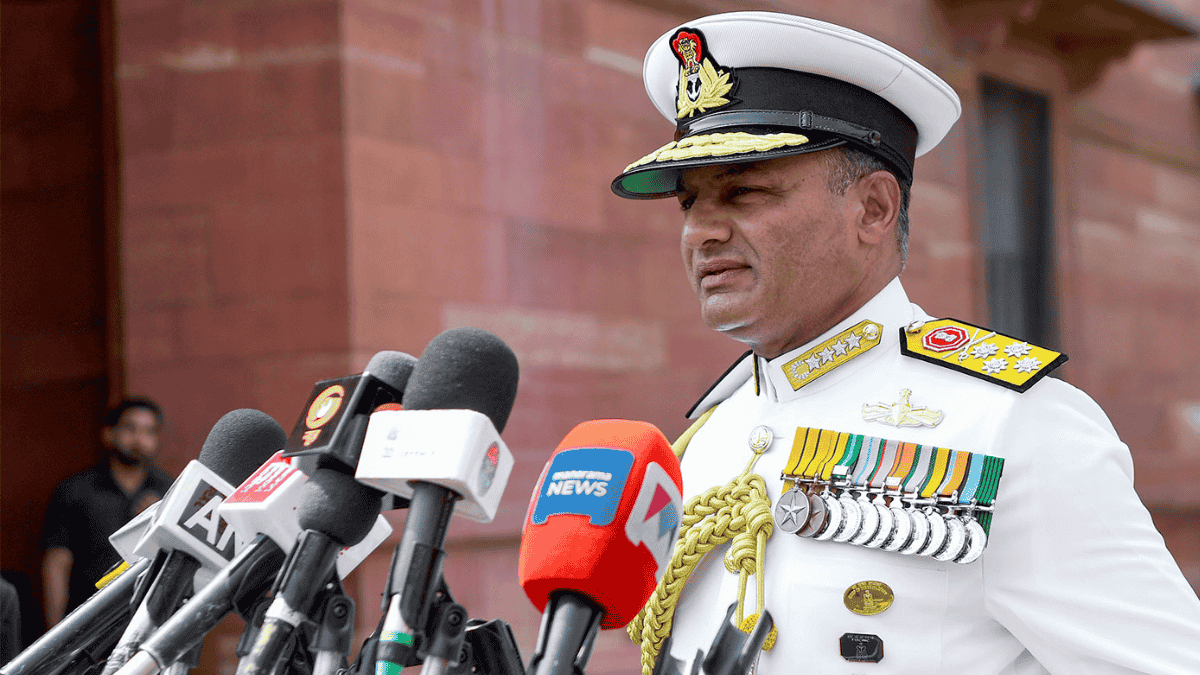
The strategic landscape of India's maritime security has witnessed a major leadership transition. On May 31, 2026, Admiral Krishna Swaminathan, PVSM, AVSM, VSM, officially assumed charge as the 27th Chief of the Naval Staff (CNS) of the Indian Navy. He succeeds Admiral Dinesh Kumar Tripathi, PVSM, AVSM, NM, who superannuated after an illustrious career spanning more than 41 years of service. This leadership transition comes at a critical juncture as the Indian Navy accelerates its transition toward complete self-reliance by 2047 and navigates an increasingly complex regional security environment in the Indo-Pacific.
This comprehensive analysis from Atharva Examwise provides the key details of this appointment, the background of the new chief, the evolving security challenges, and the broader strategic reforms occurring within the Indian Armed Forces. It serves as an essential resource for candidates preparing for the Union Public Service Commission (UPSC) Civil Services Examination and other competitive exams.
Key Facts and Exam-Relevant Data
To aid quick revision for competitive exams, the primary factual highlights of this transition are summarized below:
The Appointment: Admiral Krishna Swaminathan assumed charge as the 27th Chief of the Naval Staff on May 31, 2026, succeeding Admiral Dinesh Kumar Tripathi.
Statutory Tenure: Under the Regulations for the Navy (1991), the Chief of the Naval Staff retires after completing a term of three years or upon reaching the age of 62, whichever is earlier.
Specialization: Commissioned on July 1, 1987, Admiral Swaminathan is a specialist in Communication and Electronic Warfare.
Decorations: He is a recipient of the Param Vishisht Seva Medal (PVSM), Ati Vishisht Seva Medal (AVSM), and Vishisht Seva Medal (VSM) for his distinguished service.
Historical Evolution: The professional head of the Navy was originally designated as the "Commander-in-Chief, Royal Indian Navy" at Independence. The title "Chief of the Naval Staff" was established under the Commanders-In-Chief (Change in Designation) Act, 1955. The position was upgraded from a three-star Vice Admiral to a four-star Admiral rank in 1968.
First Indian CNS: Vice-Admiral Ram Dass Katari was the first Indian-born officer to assume charge as the Navy Chief, serving from 1958 to 1962.
Tri-Services Alignment: This transition occurred concurrently with General N. S. Raja Subramani assuming charge as the third Chief of Defence Staff (CDS) on May 31, 2026, succeeding General Anil Chauhan.
Naval Hierarchy: On May 29, 2026, Vice Admiral Ajay Kochhar assumed charge as the 48th Vice Chief of the Naval Staff (VCNS), reinforcing the leadership structure.
Profile and Academic Credentials of Admiral Krishna Swaminathan
Admiral Swaminathan represents a class of highly educated and strategically trained military professionals. Raised in Bengaluru and having spent his early naval years in Mumbai, he received his watchkeeping certificate on the Pondicherry-class minesweeper INS Alleppey. During the early 1990s, he served as the Aide-de-camp to the Governor of Uttar Pradesh, displaying versatile administrative capabilities early in his career.
Educational Qualifications
The educational credentials of Admiral Swaminathan are exceptionally broad, reflecting deep expertise in both telecommunications and international strategic studies.
| Degree / Qualification | Specialization / Focus | Granting Institution | Source |
|---|---|---|---|
| Bachelor of Science (BSc) | General Sciences | Jawaharlal Nehru University, New Delhi | |
| Master of Science (MSc) | Telecommunications | Cochin University of Science and Technology, Kochi | |
| Master of Arts (MA) | Defence Studies | King's College, London, United Kingdom | |
| Master of Philosophy (MPhil) | Strategic Studies | Mumbai University | |
| Doctor of Philosophy (PhD) | International Studies | Mumbai University | |
| Alumnus Status | Military Leadership & Strategy | National Defence Academy, Khadakwasla; Joint Services Command and Staff College, Shrivenham (UK); College of Naval Warfare, Karanja; United States Naval War College, Newport |
Command Profile and Career Milestones
During his career spanning nearly four decades, Admiral Swaminathan has held critical sea command and staff appointments across all major verticals of the Indian Navy.
| Command / Appointment | Designation / Vessel | Strategic Significance | Source |
|---|---|---|---|
| Early Commands | INS Vidyut, INS Vinash, INS Kulish | Commanded Veer-class and Kora-class missile corvettes, establishing operational experience. | |
| Destroyer Command | INS Mysore | Commanded this guided-missile destroyer during the President's Fleet Review in 2011 and joint exercises with Russia. | |
| Flagship Command | INS Vikramaditya | Served as the second Commanding Officer of India's primary aircraft carrier, a coveted command posting. | |
| Staff Officer Training | CSO (Training), Southern Naval Command | Shaped the training frameworks across the Navy and spearheaded the creation of the Indian Naval Safety Team. | |
| Operational Command | Flag Officer Commanding Western Fleet | Led the "Sword Arm" of the Navy, managing the western maritime border. | |
| Advisory Command | Flag Officer Offshore Defence Advisory Group | Advised the Government of India on offshore security and critical economic infrastructure protection. | |
| Apex Staff Roles | Chief of Staff (WNC), Controller Personnel Services, Chief of Personnel, Vice Chief of the Naval Staff | Managed the core logistics, administration, personnel, and policy formulation at Naval Headquarters. | |
| Command-in-Chief | FOC-in-C, Western Naval Command | Headed the operationally critical western formation before elevating to Chief of the Naval Staff. |
Dual Transition at the Helm: The Drive for Tri-Services Integration
The assumption of command by Admiral Swaminathan on May 31, 2026, coincides with a broader structural overhaul in the higher defense leadership of the country. This alignment represents a unique opportunity for synchronized military reforms, particularly the long-awaited transition toward theaterisation.
The Integration of a New Chief of Defence Staff (CDS)
On the same day, General N. S. Raja Subramani assumed office as India's third Chief of Defence Staff and Secretary of the Department of Military Affairs (DMA). Commissioned into the Garhwal Rifles in December 1985, General Subramani brings extensive expertise on Northern and Western border dynamics and is widely recognized as a Pakistan-China expert.
The primary mandate before General Subramani and Admiral Swaminathan is to implement the joint theaterisation plans designed to integrate the assets of the Army, Navy, and Air Force under unified theatre commands.
The Blueprint for the Maritime Theatre Command (MTC)
Before superannuating, the outgoing CDS General Anil Chauhan submitted a comprehensive proposal outlining three distinct theatre commands to optimize resource utilization and operational efficiency.
Northern Theatre Command: Headquartered in Lucknow, focused primarily on countering threats along the China border.
Western Theatre Command: Headquartered in Jaipur, designed to address conventional and unconventional threats along the Pakistan border.
Maritime Theatre Command (MTC): Headquartered in Thiruvananthapuram, this command will integrate the assets, personnel, and bases of the Indian Navy, the Indian Coast Guard, and designated tri-service elements to safeguard India’s vast Exclusive Economic Zone (EEZ) and oceanic trade corridors.
The synchronization between Admiral Swaminathan, General Subramani, and the newly appointed VCNS Vice Admiral Ajay Kochhar—who previously commanded the Western Fleet and the aircraft carrier INS Vikramaditya—is expected to accelerate the implementation of this joint command structure.
Evolving Maritime Security Threats and Key Naval Operations
The strategic environment in the Indian Ocean Region (IOR) has transitioned from traditional state-on-state posturing to a complex spectrum of asymmetric, grey-zone, and technological threats. The relevance of Admiral Swaminathan's specialization in Electronic Warfare is highlighted by these challenges.
Transitioning Threat Matrix in the Indian Ocean Region
The security challenges along India's 7,517-kilometer coastline and its 2.4 million square kilometer Exclusive Economic Zone span multiple operational theatres. Traditional security challenges, such as Chinese naval expansionism and Pakistan-supported maritime proxy assets, have been complicated by non-traditional threats, including sea-borne terrorism, pirate activity, drug running, human trafficking, and Illegal, Unreported, and Unregulated (IUU) fishing.
The vulnerability of critical offshore infrastructure, such as major ports, oil rigs, and undersea communication cables that carry over 95% of India’s digital data traffic, requires constant surveillance and swift deterrent capabilities.
Lessons from Operation Sindoor and Operation Urja Suraksha
The operational readiness of the Indian Navy was recently tested across two major theatres, demonstrating its capacity as a "First Responder" and a preferred security partner in the region.
Operation Sindoor: Originally executed as a coordinated military strike targeting hostile camps, this operation demonstrated the absolute deterrence capability of India's Carrier Battle Group (CBG). It highlighted key tactical challenges, specifically the threat of low-cost, mass-produced drone swarms, which have forced the Navy to integrate artificial intelligence-assisted targeting systems and unified counter-unmanned aerial systems (UAS) commands.
Operation Urja Suraksha: Launched to protect critical maritime trade lanes and energy supplies coming out of the Persian Gulf amid the conflict in West Asia. With over 90% of India's EXIM trade and 80% of its critical petroleum freight transiting maritime routes, any disruption in the Strait of Hormuz directly threatens economic stability and fuels domestic inflation. The sustained forward presence of Indian naval vessels in the Gulf of Aden since 2008 has successfully escorted over 3,800 merchant vessels, reinforcing the principle that "distance from conflict no longer means safety from consequences".
Sailing Towards Self-Reliance: The Roadmap to Vision 2047
Admiral Swaminathan has emphasized that indigenisation, Atmanirbharta (self-reliance), and the induction of niche, emerging technologies will remain his core Key Result Areas (KRAs). Under the Indian Naval Indigenisation Plan (INIP) 2015–2030, the Navy has systematically worked to reduce its reliance on external defense supply chains, which are highly vulnerable to global geopolitical disruptions.
Financial Commitment and Shipbuilding Success
The transition of the Navy into a "Builder's Navy" is supported by a significant expansion of the defense budget.
| Fiscal Metric | FY 2020–21 | FY 2025–26 | Strategic Implication | Source |
|---|---|---|---|---|
| Overall Defense Budget | ~₹4.71 lakh crore | ₹6.81 lakh crore | Substantial fiscal expansion to support modernization across all three services. | |
| Indian Navy Total Budget | ₹49,623 crore | ₹1,03,548 crore | Budget has nearly doubled, reflecting the rising strategic priority of the maritime domain. | |
| Naval Share of Defense Budget | 15% | 21% | Shift in capital prioritization to address Chinese naval posturing in the IOR. | |
| Naval Capital Expenditure | ₹26,688 crore | ₹62,545 crore | Funding dedicated exclusively to the procurement of ships, submarines, and advanced weaponry. |
Currently, 45 to 51 large warships valued at approximately ₹90,000 crore are under construction exclusively in domestic shipyards. This shipbuilding capability was highlighted by the commissioning of the 100th and 101st indigenous warships, INS Udaygiri and INS Himgiri, which incorporated warship-grade steel developed jointly by the Navy, DRDO, and SAIL.
Modernization and High-End Technology Acquisition
The next frontier of naval indigenisation involves transitioning from basic hull fabrication to sovereign design, integration, and development of high-end propulsion systems, sensors, and complex weaponry.
Undersea Domain Modernization: Guided by a 30-year submarine building program, the Navy is in the final procurement stages under Project-75(I) to construct six next-generation conventional submarines equipped with Air Independent Propulsion (AIP) through technology-transfer and domestic manufacturing.
Carrier Aviation: To maintain deck-based air power, an Inter-Governmental Agreement has been signed for the procurement of 26 Rafale-Marine aircraft to be delivered between 2028 and 2030.
Unmanned Capabilities: The Navy has placed a contract for 31 MQ-9B Sky/Sea Guardian High Altitude Long Endurance (HALE) Remotely Piloted Aircraft Systems (RPAS), with deliveries commencing in 2029 to provide continuous surveillance from seabed to space.
Policy and SPRINT Framework: The Naval Innovation and Indigenisation Organisation (NIIO), established in 2020, alongside the SPRINT challenges, has successfully collaborated with over 213 MSMEs and startups to induct at least 75 niche technologies into the fleet. The SRIJAN portal has uploaded over 38,000 items, of which over 14,000 have been successfully indigenised by the armed services.
Why this matters for your exam preparation
For serious aspirants targeting UPSC and competitive exams, this update carries significant weight across both Prelims and Mains formats.
UPSC Civil Services Prelims (General Knowledge and Current Affairs)
Defense Appointments and Leadership: Questions frequently target the role, tenure, and statutory provisions governing the Chief of the Naval Staff, the Chief of Defence Staff, and their advisory roles within the National Security Council (NSC) and the Defence Acquisition Council (DAC).
Military Hardware and Platforms: Understanding the classification of vessels like guided-missile destroyers (INS Mysore), aircraft carriers (INS Vikramaditya, INS Vikrant), and the status of advanced platforms (Project-75I, Rafale-M, MQ-9B) is highly high-yield.
Security Operations: Aspirants must be familiar with the objectives and geographical contexts of recent operations, such as Operation Sindoor (counter-terrorism and drone warfare) and Operation Urja Suraksha (energy security in the Persian Gulf and Strait of Hormuz).
UPSC Civil Services Mains (General Studies Paper III)
Internal Security and Border Management: The porous nature of India's coastline, maritime policing gaps, and the role of the Indian Coast Guard and Marine Police under the three-tier security grid can be discussed using contemporary references to the proposed Maritime Theatre Command.
Defense Technology and Indigenisation: Mains questions regarding "Atmanirbharta in Defense" can be supported by citing specific data from the Indian Naval Indigenisation Plan (INIP), the progress of Float/Move/Fight categories, and policy initiatives like NIIO, iDEX funding structures, and the SPRINT challenges.
Energy and Maritime Infrastructure: The economic correlation between uninterrupted maritime trade and domestic inflation is a critical analytical point. Candidates can write strong answers on "Blue Economy" objectives under the SAGAR framework by highlighting the security umbrella provided by the Navy.
UPSC Civil Services Mains (General Studies Paper II)
India's Foreign Policy and Regional Strategy: The concept of India acting as a "Net Security Provider" in the Indian Ocean Region can be analyzed through the lens of humanitarian assistance, disaster relief (HADR), anti-piracy patrols, and strategic posturing against external expansionism in the Indo-Pacific.
For more exhaustive analyses of vital security developments and to practice daily answer writing, explore the(https://www.atharvaexamwise.com/upsc-gs3-internal-security) and review our structured guides on(https://www.atharvaexamwise.com/upsc-exam-preparation). Credible policy updates and official notifications can be further validated through the(https://www.pib.gov.in/PressReleasePage.aspx?PRID=2267227) archive.