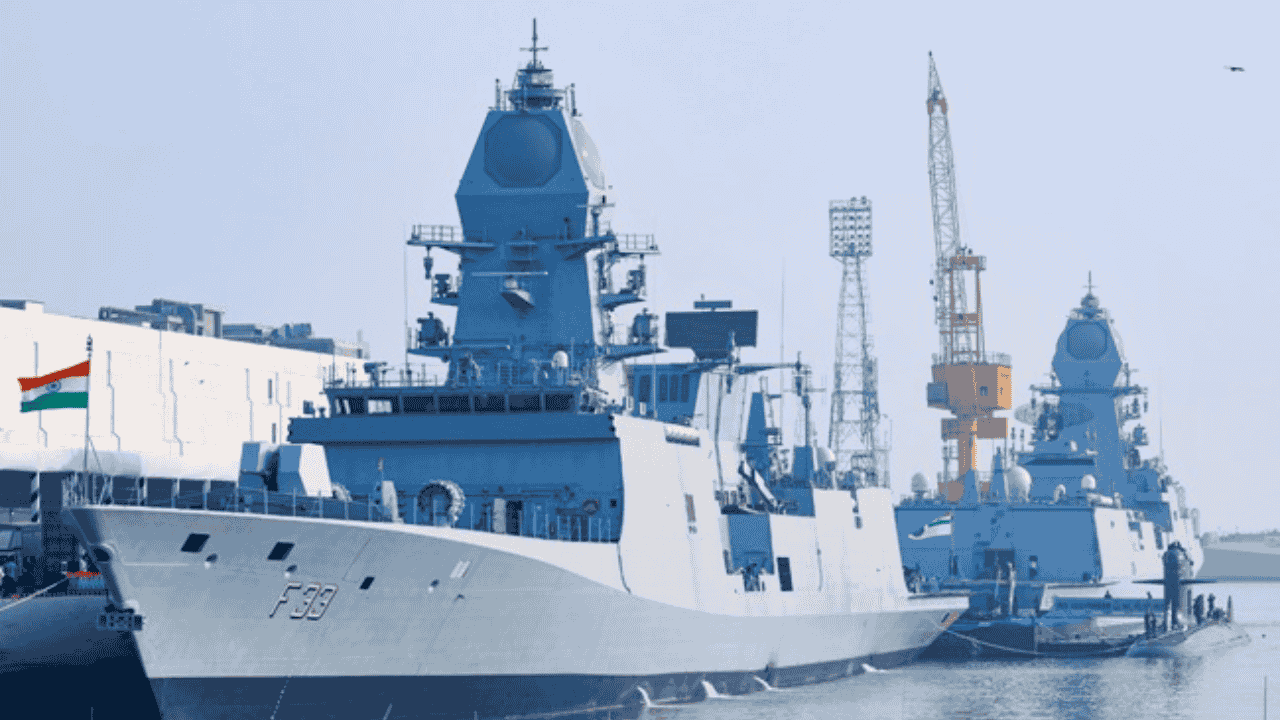
The geopolitical landscape of the twenty-first century has increasingly shifted toward the maritime domain, making the security of sea lanes and strategic autonomy a paramount concern for developing and developed nations alike. In a massive stride toward bolstering its strategic deterrence and conventional combat readiness, the Indian Navy simultaneously commissioned its third nuclear-powered ballistic missile submarine, INS Aridaman, and the highly advanced stealth frigate, INS Taragiri, on Friday, April 3, 2026. Defence Minister Rajnath Singh presided over the commissioning ceremonies in Visakhapatnam, marking a defining moment in the modern naval history of the country. This comprehensive research report evaluates the technical specifications, strategic implications, and doctrinal alignment of these new inductions, providing thorough context and rigorous analysis for candidates preparing for the Union Public Service Commission and other competitive examinations.
The Strategic Depth of the Sea-Based Nuclear Deterrent and INS Aridaman
The induction of INS Aridaman constitutes the expansion of the highly classified Advanced Technology Vessel project, which serves as the cornerstone of the sea-based leg of the strategic nuclear triad. As a ship submersible ballistic nuclear vessel, the platform differs fundamentally from conventional diesel-electric attack submarines. While conventional submarines are constrained by the need to surface or use a snorkel regularly to run diesel engines and recharge their battery systems, a nuclear reactor allows unlimited underwater endurance limited only by crew fatigue and onboard provisions.
INS Aridaman is a 7,000-tonne vessel that represents a substantial scale-up compared to its predecessors in the Arihant class, namely the lead vessel INS Arihant and the second submarine INS Arighaat. The vessel features double the number of vertical launching system tubes compared to the earlier iterations, providing a dramatically increased payload capacity for strategic missiles. The reactor powering this vessel is an advanced pressurized water reactor that grants the boat the ability to remain submerged for extended durations, evading modern satellite tracking and acoustic detection systems deployed by adversaries.
The submarine is equipped to deploy the K-15 Sagarika submarine-launched ballistic missile, possessing a range of approximately 750 kilometers, as well as the K-4 intermediate-range nuclear-capable submarine-launched ballistic missile, which boasts a strike range of up to 3,500 kilometers. The realization of the K-4 system on this platform drastically alters the regional balance of power. While the shorter range of the K-15 required submarines to move dangerously close to hostile shores or navigate toward the highly monitored northeastern fringes of the Bay of Bengal to achieve targeting parameters against major population centers, the K-4 enables retaliatory strikes from secure naval bastions near the home coast.
| Submarine Platform | Commissioning Year | Displacement | Vertical Launch Tubes | Primary Strategic Missiles |
|---|---|---|---|---|
| INS Arihant | 2016 | ~6,000 tonnes | 4 | K-15, K-4 |
| INS Arighaat | 2024 | ~6,000 tonnes | 4 | K-15, K-4 |
| INS Aridaman | 2026 | 7,000 tonnes | 8 | K-15, K-4 (Expanded Payload) |
With the induction of this third boat, the military structure enters a phase where continuous at-sea deterrence becomes a tangible operational reality. To maintain a credible deterrent at all times, a navy typically requires a minimum of three to four vessels of this class to account for routine maintenance cycles, training, and operational transit times. A fourth submarine of the Arihant class is currently under active construction, which will complete this foundational operational requirement.
The Evolution of India Nuclear Triad and the Doctrine of Credible Minimum Deterrence
To comprehend the importance of the underwater ballistic missile capability, candidates must view it through the lens of the established nuclear doctrine of the nation. Following the Pokhran-II nuclear tests in 1998, a comprehensive doctrine was officially released in 2003, built on the concepts of no-first-use and credible minimum deterrence.
Under a strict no-first-use policy, the nation pledges never to initiate the use of nuclear weapons against any adversary. However, the doctrine also clearly states that in the event of a nuclear strike against the territory or forces of the country, the retaliation will be massive, punitive, and intended to cause unacceptable damage. For such a policy to remain a credible deterrent that effectively prevents an enemy from launching a surprise first strike, the nuclear forces must be highly survivable.
The nuclear triad encompasses the ability to launch nuclear weapons from three distinct vectors: land-based ballistic missiles, aircraft-delivered bombs, and submarine-launched missiles. Land-based platforms such as the Agni series are highly responsive but remain vulnerable to preemptive strikes as satellite imagery and modern surveillance can map static silos or track mobile launchers. Air-based vectors face similar tracking vulnerabilities and may be intercepted by advanced air defense grids.
| Nuclear Triad Leg | Primary Delivery Platforms | Strategic Characteristics | Vulnerability Assessment |
|---|---|---|---|
| Land-Based | Agni series ballistic missiles | Highly responsive, large payloads | Moderate (Silos can be mapped and targeted) |
| Air-Based | Strategic strike aircraft (Sukhoi, Rafale) | Flexible targeting, recallable | High (Vulnerable to air defense and airfield destruction) |
| Sea-Based | Arihant-class SSBNs | Ultimate stealth, near-unlimited endurance | Extremely Low (Deep ocean operations evade detection) |
The sea-based leg provided by SSBNs constitutes the ultimate guarantee of a second-strike capability. Because an SSBN moving in deep oceanic waters cannot be reliably tracked by current technology, it guarantees that even if a devastating first strike destroys land silos and grounded aircraft fleets, the submarines on deterrence patrol will remain intact to deliver the authorized retaliatory blow. Consequently, the operationalization of INS Aridaman removes any rational incentive for an adversary to consider a preemptive nuclear strike, significantly stabilizing the strategic environment in South Asia.
Fleet Augmentation and Surface Supremacy The Commissioning of INS Taragiri
While INS Aridaman fulfills a strategic, over-the-horizon deterrent role, the surface fleet requires highly capable, multi-dimensional platforms to handle conventional warfare, maritime security operations, and humanitarian crises. The commissioning of INS Taragiri at the Naval Dockyard in Visakhapatnam directly addresses this operational need.
INS Taragiri is the fourth vessel constructed under Project 17A of the Nilgiri-class stealth guided-missile frigates. With a displacement of approximately 6,670 tonnes, the ship represents a generational leap over preceding designs. The Warship Design Bureau designed the vessel with a specific focus on low observability, utilizing advanced geometry and radar-absorbent materials to achieve a significantly reduced radar cross-section. This lethal stealth allows the platform to operate with higher survivability in contested environments where adversaries deploy dense sensor networks.
The propulsion system relies on a Combined Diesel or Gas configuration, allowing high-speed transit to reach crises rapidly while preserving the option for fuel-efficient, long-endurance patrols. The combat capabilities of the frigate are built around a heavily integrated ecosystem including the BrahMos supersonic surface-to-surface cruise missile, medium-range surface-to-air missiles, and an indigenously developed anti-submarine warfare suite comprising heavy torpedoes and depth rockets. These weapons are managed by an advanced combat management system that automates target acquisition and threat evaluation, granting the crew split-second reaction times in combat scenarios.
| Specification Parameter | INS Taragiri Details |
|---|---|
| Displacement | Approximately 6,670 tonnes |
| Shipbuilder | Mazagon Dock Shipbuilders Limited (MDL), Mumbai |
| Propulsion System | Combined Diesel or Gas (CODOG) |
| Primary Offensive Missile | BrahMos Supersonic Surface-to-Surface Cruise Missile |
| Defensive Suite | Medium-Range Surface-to-Air Missiles (MRSAM) |
| Indigenous Content | Exceeds 75 percent |
The frigate is built to be a multi-role asset. Beyond traditional high-intensity naval combat, the vessel fits perfectly into non-traditional security operations including coastal surveillance, anti-piracy missions in the Gulf of Aden, and humanitarian assistance and disaster relief deployments across the wider Indian Ocean.
The Legacy of the Leander Class and Technological Transition
The name Taragiri carries a deep legacy in the history of the modern navy. The original INS Taragiri was the fifth of the Leander-class frigates, commissioned in 1980 and decommissioned in 2013. The Leander class was a pioneering force in its own time, acting as the bridge that transitioned the surface fleet toward digital electronic systems and multi-dimensional capabilities.
The massive evolution in technology between the 1980 vessel and the 2026 platform reflects the broader structural shift in naval engineering. Modern warships are no longer purely centered around massive guns and thick armor plating. Instead, the focus has shifted toward electronic warfare, sensor integration, and stealth profiles.
In contemporary maritime operations, software and signal processing are just as critical as heavy armaments. Modern conflicts, as highlighted in previous examinations of global logistics and technology, show that combatants often fight with invisible electromagnetic waves. Ships must be capable of recognizing and defeating cyber-electromagnetic threats such as GPS jamming and signal spoofing. Candidates looking to understand the full scope of these invisible warfare tactics can read the detailed research report on(https://www.atharvaexamwise.com/current-affairs-details/627). This integration of advanced combat systems ensures that platforms like the new INS Taragiri maintain their operational edge even when satellite communications are severely degraded by enemy action.
Self Reliance and the Role of MSMEs in Defence Production
A core theme emphasized by the Ministry of Defence during the commissioning ceremonies was the success of indigenous ship building prowess. Historically, the defense framework was heavily dependent on foreign acquisitions, importing everything from basic sensors to entire capital warships. This created a severe global governance deficit and left the nation vulnerable to supply chain manipulations and strategic leverage by external state actors.
Under current initiatives, defense manufacturing has been treated as a central national mission aimed at achieving complete Aatmanirbharta. INS Taragiri exemplifies this focus, as over 75 percent of the ship has been indigenously produced. This was accomplished through a robust public-private collaboration involving Mazagon Dock Shipbuilders Limited and over 200 domestic Micro, Small, and Medium Enterprises. These smaller companies provided critical specialized components, proving that the domestic industrial ecosystem has matured to support complex defense projects.
Beyond the direct strategic benefit of being immune to external supply sanctions, localized manufacturing creates a powerful economic multiplier effect. The domestic production of these highly complex systems stimulates advanced research and development, fosters specialized engineering skills, and generates thousands of high-quality industrial jobs within the country.
Candidates preparing for economics and developmental papers should note how policy measures in heavy industry create spillover effects across the entire economic spectrum. Similar to how agricultural shifts can modernize regional economies, as outlined in the analysis of Malda organic mango production and its global export potential on Atharva Examwise, defense indigenization forces the growth of high-technology small businesses. Furthermore, understanding how localized production insulates the national economy from aggressive external trade measures is critical. Candidates can analyze these broader trade dynamics in the Atharva Examwise analysis of global tariffs and their domestic consequences.
Maritime Security Challenges and Chokepoint Vulnerability in the 21st Century
The geographic realities of the nation place it at the absolute center of global maritime commerce. Surrounding the peninsula are vast oceanic stretches containing numerous sensitive choke points, including the Strait of Malacca to the east and the Strait of Hormuz to the west.
The vast majority of data and massive percentages of global trade travel through undersea internet cables and defined maritime routes. Any physical damage to these underwater fiber-optic networks or disruptions at maritime choke points carries the potential to paralyze the global order and destabilize financial institutions. The ongoing conflict in West Asia stands as a clear demonstration of how localized skirmishes immediately impact global energy security and supply chain stability. When commercial tankers were threatened in the Strait of Hormuz, the navy deployed assets to actively escort Indian-flagged vessels, securing national energy interests.
Defence Minister Rajnath Singh heavily emphasized that the mission profile of the navy can no longer be limited to simply safeguarding physical coastlines. Instead, the force must maintain sustained presence and continuous surveillance over critical sea lanes, choke points, and digital infrastructure that are inextricably linked to national interests.
This expanded mandate requires a high volume of capable ships. While heavy strategic assets like INS Aridaman secure the ultimate survival of the state, workhorse platforms like INS Taragiri are required on a daily basis to deter pirates, respond to natural disasters, and demonstrate consistent physical presence in distant waters to reassure trading partners and prevent the rise of non-state actors in the global commons.
Furthermore, security challenges are increasingly interlinked with technological and environmental shifts. Aspirants must understand that the modern definition of national security is comprehensive, encompassing military defense, economic stability, and even ecological safeguarding. Just as the defense forces protect physical borders, the nation must develop responses to invisible threats. For a case study on addressing non-traditional, biological security threats, candidates are encouraged to read the Atharva Examwise report on the accumulation of nanoplastics in human biology, which explores how industrial polymers are bypassing biological barriers. This demonstrates that security in the modern era requires a multi-pronged focus on both conventional hardware and advanced scientific monitoring.
| Challenge Domain | Primary Security Threats | Strategic Naval Response |
|---|---|---|
| Conventional Warfare | Hostile fleet deployments, submarine infiltration | Deployment of stealth frigates (INS Taragiri) and carrier battle groups |
| Strategic Deterrence | Surprise nuclear first strikes by adversaries | Operation of Arihant-class SSBNs to guarantee second-strike capability |
| Asymmetric & Gray Zone | GPS spoofing, cyber attacks on naval networks | Integration of hardened combat management systems and electronic warfare suites |
| Non-Traditional Security | Maritime piracy, humanitarian crises, chokepoint blockades | Sustained presence patrols, active escort operations for commercial vessels |
Future Outlook for Fleet Augmentation and Strategic Tech
The commissioning of these two platforms is part of a larger, highly ambitious plan to transition the navy into a fully capable blue-water force. Since last year, the service has successfully commissioned 12 ships, 1 submarine, and 1 aircraft squadron. This frantic pace of fleet augmentation is driven by the realization that maritime dominance will dictate geopolitical standing in the mid-twenty-first century.
While completing the Arihant-class SSBN program remains a high priority, planners are also actively pursuing a nuclear-powered attack submarine program. Unlike SSBNs that carry massive strategic missiles and hide in deep bastions as a deterrent, SSNs are designed to act as tactical hunters. They are equipped with conventional torpedoes and land-attack cruise missiles, designed to track enemy submarines, escort friendly carrier battle groups, and conduct rapid surveillance operations. The Navy plans to build two SSNs indigenously and acquire one on lease from Russia expected to arrive by 2027-2028 to bolster capability gaps while the domestic boats are under construction.
This dual focus on expanding both the strategic deterrent and the conventional surface combatants ensures that the country maintains a credible deterrent against full-scale war while possessing the flexible, precise tools required to manage daily security operations and fulfill its responsibilities as a net security provider across the Indian Ocean.
Key Facts and Exam Relevant Data
INS Aridaman Class and Displacement: S4, third vessel of the Arihant-class SSBNs, displacing 7,000 tonnes.
Arihant-Class Predecessors: INS Arihant (commissioned 2016) and INS Arighaat (commissioned August 2024).
Submarine Missile Systems: Carries K-15 (750 km range) and K-4 SLBMs (3,500 km range).
Nuclear Triad Status: India is among a select group including the US, Russia, China, and France possessing operational nuclear triads.
INS Taragiri Specifications: Project 17A Nilgiri-class stealth frigate, displacing 6,670 tonnes.
Indigenization Target: Over 75 percent of INS Taragiri constructed using domestic resources, involving 200 MSMEs.
Primary Armament of Taragiri: BrahMos supersonic surface-to-surface cruise missiles and MRSAM air defense systems.
Legacy Reference: The previous INS Taragiri was a Leander-class frigate serving from 1980 to 2013.
Why this matters for your exam preparation
For serious aspirants targeting the Union Public Service Commission Civil Services Examination and other competitive state examinations, maritime security and strategic deterrence constitute high-priority areas that appear repeatedly across multiple papers. Analyzing these commissioning events goes beyond simply memorizing ship names; it requires understanding the structural shifts in the national defense posture and foreign policy.
In General Studies Paper 3 (Internal Security and Border Management), the syllabus specifically demands comprehension of security challenges and their management in border areas, including coastal and maritime security. Candidates should be prepared to discuss the complexities of defending a coastline extending over 11,000 kilometers and the necessity of platforms like the Project 17A frigates to maintain regional stability. Furthermore, questions concerning the linkages between organized crime, piracy, and terrorism at sea often expect candidates to propose actionable solutions involving inter-agency coordination and advanced surveillance technologies.
In General Studies Paper 3 (Science and Technology), awareness of developments in defense technology is explicitly mentioned in the syllabus. Aspirants should understand the distinction between conventional and nuclear propulsion in submarines, the physics behind radar-evading stealth ship designs, and the strategic capabilities of the K-4 submarine-launched ballistic missiles. Evaluative questions may expect candidates to assess whether the indigenization model used for INS Taragiri can be effectively scaled up to eliminate reliance on foreign defense imports entirely.
In General Studies Paper 2 (International Relations), the role of the Indian Navy as a net security provider and the concept of maritime domain awareness are frequently tested in questions regarding the Indo-Pacific region and the security of global commons. The operations to secure commercial shipping during West Asia disruptions prove how naval hard power directly interfaces with foreign policy objectives and economic diplomacy.
When approaching these topics in Mains answer writing, candidates are advised to move beyond basic factual recitations. Effective answers will synthesize the cause-and-effect relationships between strategic doctrines like no-first-use and the physical hardware deployed to uphold them. Utilizing case studies of successful indigenization involving the MSME sector can provide balanced, high-scoring dimensions to questions regarding industrial development and self-reliance. Consistent engagement with daily updates from platforms like Atharva Examwise will ensure that your preparation reflects both static theoretical frameworks and fast-evolving contemporary realities.