
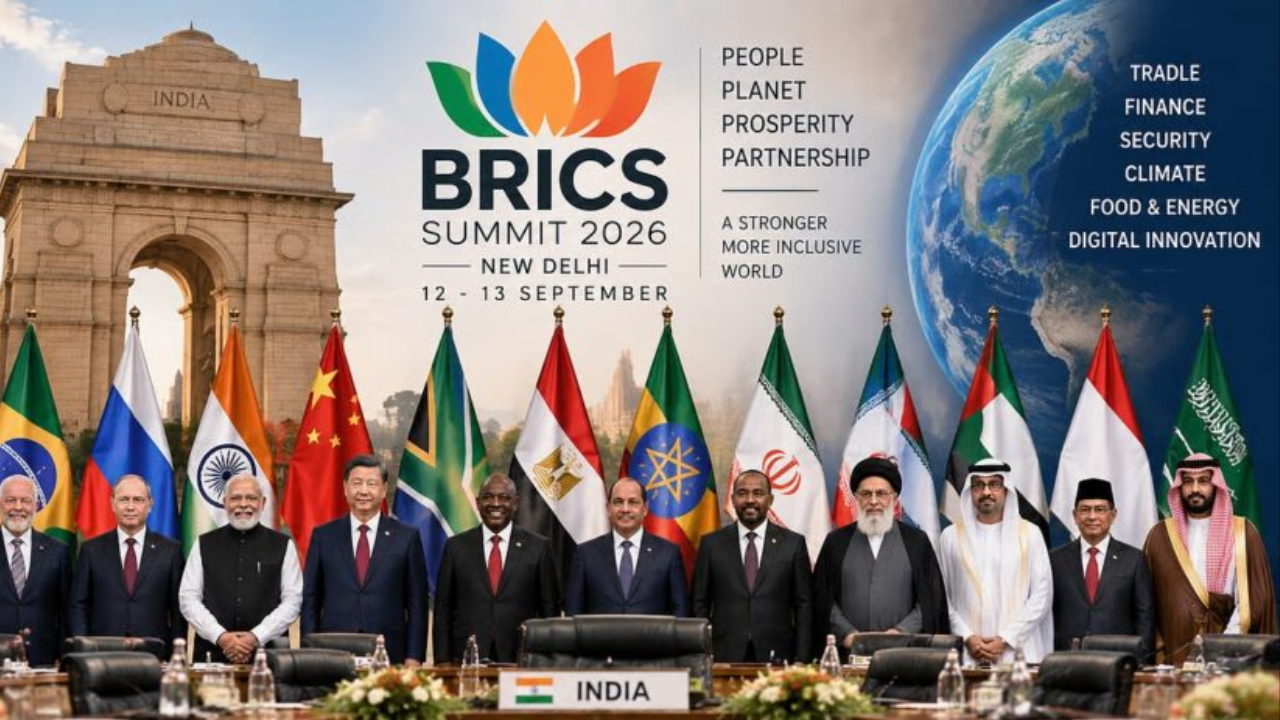
UPSC Current Affairs: India Leads 18th BRICS Summit 2026 in New Delhi | Daily GK Update
The ongoing transformation of global multilateralism reaches a defining milestone as India assumes the rotational presidency of the BRICS grouping for 2026, culminating in the 18th BRICS Leaders' Summit scheduled for September 12–13, 2026, in New Delhi. Convened at Bharat Mandapam—the historic site of the 2023 G20 Leaders' Summit—this summit marks India's fourth tenure as BRICS chair, following successful presidencies in 2012, 2016, and 2021. The 2026 proceedings also celebrate two decades since the initial ministerial convergence of the bloc in 2006, highlighting its evolution from an investment thesis into an influential intergovernmental coalition spanning eleven nations across five continents.
For civil services aspirants monitoring Atharva Examwise current news, understanding the institutional trajectory, financial mechanisms, and strategic calculations of BRICS is essential for General Studies Paper II (Bilateral, Regional, and Global Groupings) as well as the Preliminary General Studies examinations.
Summit Architecture: India's 2026 Leadership Framework
India formally assumed the BRICS chairship on January 1, 2026. Under the overarching philosophical vision of "Humanity First" articulated by Prime Minister Narendra Modi, India has anchored its 2026 agenda on four operational pillars: Resilience, Innovation, Cooperation, and Sustainability.
The chairship departs from traditional centralized diplomatic summits by distributing multilateral engagements across multiple urban hubs, organizing more than 350 technical working group sessions and 25 ministerial conferences across India.
| Summit Dimension | Strategic Parameter |
|---|---|
| Summit Edition | 18th BRICS Leaders' Summit |
| Dates of Convention | September 12–13, 2026 |
| Host Venue | Bharat Mandapam, Pragati Maidan, New Delhi, India |
| Historical Milestone | 20th Anniversary of BRICS Ministerial Foundation (2006–2026) |
| Presidency Cycle | India's 4th Chairship (preceded by 2012, 2016, and 2021) |
| Guiding Theme | Building for Resilience, Innovation, Cooperation, and Sustainability |
| Economic Representation | 11 Full Member Nations across 5 Continents |
Evolution of BRICS: From Conceptual Acronym to 11-Nation Bloc
The genesis of BRIC originates in a 2001 macroeconomic projection by Goldman Sachs chief economist Jim O'Neill, which theorized that the emerging market economies of Brazil, Russia, India, and China would collectively outstrip the economic weight of the G7 nations. This conceptual framework crystallized into formal multilateral diplomacy in September 2006, when the foreign ministers of the four founding nations met along the margins of the 61st United Nations General Assembly in New York. The first formal head-of-state summit convened in Yekaterinburg, Russia, in 2009.
The grouping formally incorporated South Africa in 2010, attending its first summit at Sanya in 2011, establishing the familiar "BRICS" nomenclature. Following more than a decade of consolidated five-member deliberations, the 2023 Johannesburg Summit initiated an institutional expansion. On January 1, 2024, Egypt, Ethiopia, Iran, Saudi Arabia, and the United Arab Emirates joined as full members. Indonesia's accession in January 2025 expanded the bloc to eleven full members, creating an expansive platform bridging major resource-exporting and manufacturing economies.
| Year | Milestone / Structural Development | Significance for Global Governance |
|---|---|---|
| 2001 | Coining of "BRIC" Acronym | Conceptual recognition of emerging economic growth drivers. |
| 2006 | Inaugural Foreign Ministers' Meeting | Political formalization at the UN General Assembly margins. |
| 2009 | 1st BRIC Leaders' Summit (Yekaterinburg) | Institutionalized annual heads-of-state multilateral summits. |
| 2010–2011 | Accession of South Africa | Geographic broadening to the African continent; BRICS adopted. |
| 2014 | Fortaleza Summit (6th Summit) | Treaty establishing the New Development Bank and CRA. |
| 2024 | First Wave of Historic Expansion | Accession of Egypt, Ethiopia, Iran, Saudi Arabia, and UAE. |
| 2025 | Accession of Indonesia | Inclusion of Southeast Asia's largest economy as 11th member. |
| 2026 | 18th Summit Hosted by India | New Delhi Summit focuses on consolidation and resilience. |
Key Facts: Operational Track-Two Engagements and Sectoral Initiatives
Much like participants in a coordinated academic project who divide research, design, and analytical roles to maximize shared output, sovereign states pool specialized scientific, logistical, and technical capabilities to overcome transnational collective action problems. Throughout 2026, India's chairship activated these cooperative advantages across several key tracks:
Cultural Exchange and Heritage Preservation: Bhopal hosted the ministerial-level BRICS Culture Meeting, formalizing digitizing frameworks for intangible cultural heritage and expanding joint creative economy ventures.
Oceanographic and Polar Scientific Research: Consortium scientists from the member nations launched harmonized deep-sea ecological surveys and polar research expeditions, analyzing oceanic carbon sequestration and changes in polar ice sheets.
Future-Ready Learning and Artificial Intelligence: Educational working groups met to construct standardized frameworks for artificial intelligence (AI) literacy, technical vocational training, and the ethical management of algorithmic workplace disruptions.
Youth Diplomatic Leadership: In May 2026, the BRICS Young Diplomats Forum convened in New Delhi, hosting emerging foreign policy specialists to discuss international conflict resolution, international law, and multilateral crisis communication.
Deep-Tech Innovation Showcase: Parallel to the central summit, the BRICS Bharat Innovates Exposition at Bharat Mandapam presented 37 high-growth Indian deep-tech enterprises to international delegations, focusing on clean energy transitions, biotech, and sovereign AI computing architectures.
Institutional Financial Mechanisms: New Development Bank and Contingent Reserve Arrangement
The operational credibility of BRICS rests heavily on its alternative financial architecture, created to supplement traditional Bretton Woods institutions such as the International Monetary Fund (IMF) and the World Bank.
New Development Bank (NDB)
Formally established during the 2014 Fortaleza Summit, the New Development Bank is headquartered in Shanghai, China. The institution finances infrastructure and sustainable development initiatives across member states, emerging markets, and developing nations.
Departing from the quota-based voting power configurations characteristic of Western-led multilateral development banks, the NDB was founded on the principle of sovereign equality, granting equal voting shares to each founding member regardless of domestic capital contribution levels.
Contingent Reserve Arrangement (CRA)
Operating as a collective self-defense currency mechanism, the Contingent Reserve Arrangement supplies liquidity buffers to member states confronting short-term balance-of-payments crises. The CRA minimizes the vulnerability of emerging market currencies to international capital flight, global monetary tightening, and speculative market behavior, reinforcing macro-financial resilience.
Exam-Relevant Data: Demographics, Trade, and Global Economic Weight
Understanding the quantitative strength of the enlarged 11-member bloc is vital for objective and descriptive assessments across competitive examinations:
Demographic Representation: The 11 member nations represent nearly half of the global population, providing unmatched domestic consumer markets and workforce potential.
Global Output Share: The expanded bloc accounts for approximately 40% of global Gross Domestic Product (GDP) when calculated on a Purchasing Power Parity (PPP) basis.
International Commerce: BRICS member states collectively control roughly 25% of global merchandise trade.
Intra-Bloc Trade Expansion: Bilateral and multilateral merchandise trade among BRICS nations reached approximately $1.17 trillion in 2024, demonstrating deepening trade interlinkages.
India's Commercial Footprint: In the 2025–26 financial year, India exported approximately $82 billion in goods to fellow BRICS members, complemented by an estimated $31.3 billion in services trade in 2024.
Strategic Analysis: India's Multi-Alignment Policy and Geopolitical Challenges
The 18th BRICS Summit highlights the core principles of India's contemporary foreign policy: strategic autonomy and multi-alignment. India avoids zero-sum geopolitical binary choices by engaging in multilateral formations that reflect complementary national interests. While New Delhi partners with the United States, Japan, and Australia in the Quadrilateral Security Dialogue (Quad) to ensure maritime security and a rules-based order across the Indo-Pacific, it concurrently exercises leadership within BRICS to champion the priorities of the Global South and press for systemic governance reforms within the United Nations Security Council (UNSC) and multilateral financial systems. Detailed breakdowns of these diplomatic doctrines are available in the Atharva Examwise International Relations Module.
A critical analytical distinction for aspirants concerns India's clear position regarding global currency arrangements. India firmly opposes unilateral "de-dollarization" agendas or proposals advocating for a single, unified BRICS currency. Official statements confirm that New Delhi does not endorse any collective financial mechanism intended to assault the US dollar or replace it with a China-centric settlement architecture.
Instead, India champions bilateral local-currency settlements—utilizing national currencies such as the Indian Rupee, UAE Dirham, and Russian Ruble—to lower transaction costs, reduce foreign exchange conversion risks, and optimize trade settlements. Concurrently, India has prioritized establishing interoperable frameworks for Central Bank Digital Currencies (CBDCs) to modernize cross-border clearing systems without creating systemic external dependencies.
Nevertheless, structural contradictions continue to challenge the internal cohesiveness of an expanded 11-nation BRICS:
Sino-Indian Strategic Rivalry: Lingering boundary tensions along the Line of Actual Control (LAC) and overlapping maritime ambitions across the Indian Ocean place clear upper boundaries on comprehensive defense and security alignment within the grouping.
West Asian Internal Divergences: The simultaneous presence of Iran alongside the United Arab Emirates and Saudi Arabia creates a complex diplomatic balance within the bloc, especially during heightened regional frictions and maritime transit security disputes.
Nile Basin Resource Tensions: North and East African accessions carry long-standing geopolitical friction, exemplified by the dispute between Egypt and Ethiopia over the operational management of the Grand Ethiopian Renaissance Dam (GERD), compounded by conflicting foreign policy postures concerning Somaliland.
Preserving Institutional Balance: India exercises a steady, moderating influence within BRICS to ensure the forum concentrates on sovereign development finance, technology sharing, and multilateral equity, actively preventing the bloc from transforming into an adversarial, anti-Western geopolitical bloc.
Why this matters for your exam preparation
The geopolitical, economic, and institutional dimensions of the 18th BRICS Summit provide essential material for candidates appearing in the UPSC Civil Services Examination (CSE), State PSC exams, and other competitive selections.
Relevance for UPSC Prelims
Institutional Facts and Headquarters: Candidates should note institutional specifics, such as the headquarters of the New Development Bank in Shanghai, its equal voting governance architecture, and the operational mandate of the Contingent Reserve Arrangement.
Membership Chronology: Questions frequently test accession timelines, distinguishing between the original 2006 BRIC foundation, South Africa's entry in 2010–2011, the 2024 expansion (Egypt, Ethiopia, Iran, Saudi Arabia, UAE), and Indonesia's full integration in January 2025.
Summit Host Geography and Themes: Memorize the host city (New Delhi), host venue (Bharat Mandapam), and India's four chairship pillars (Resilience, Innovation, Cooperation, and Sustainability).
Relevance for UPSC Mains (General Studies Paper II)
Global Groupings and Strategic Autonomy: India's navigation of BRICS, the Quad, and the SCO illustrates modern multi-alignment diplomacy, offering analytical material for essays and foreign policy answers.
Global Governance Reforms: The bloc serves as a primary vehicle for demanding structural recalibrations within the UNSC, the IMF, and the World Bank to better represent the Global South.
Economic Diplomacy and De-Dollarization: Aspirants must clearly distinguish between India's rejection of a unified common currency and its pragmatic promotion of bilateral local-currency invoicing mechanisms.
Mains Practice Question
"The expansion of BRICS to an eleven-member bloc reflects the rising demand for multipolarity, yet accentuates internal geopolitical contradictions. Critically examine how India balances its strategic autonomy while ensuring the grouping does not devolve into an anti-Western platform." (250 Words, 15 Marks)
Aspirants can access structured model answers, analytical current affairs dossiers, and practice mock tests through the Atharva Examwise Test Series, verified against official updates from the Ministry of External Affairs.