
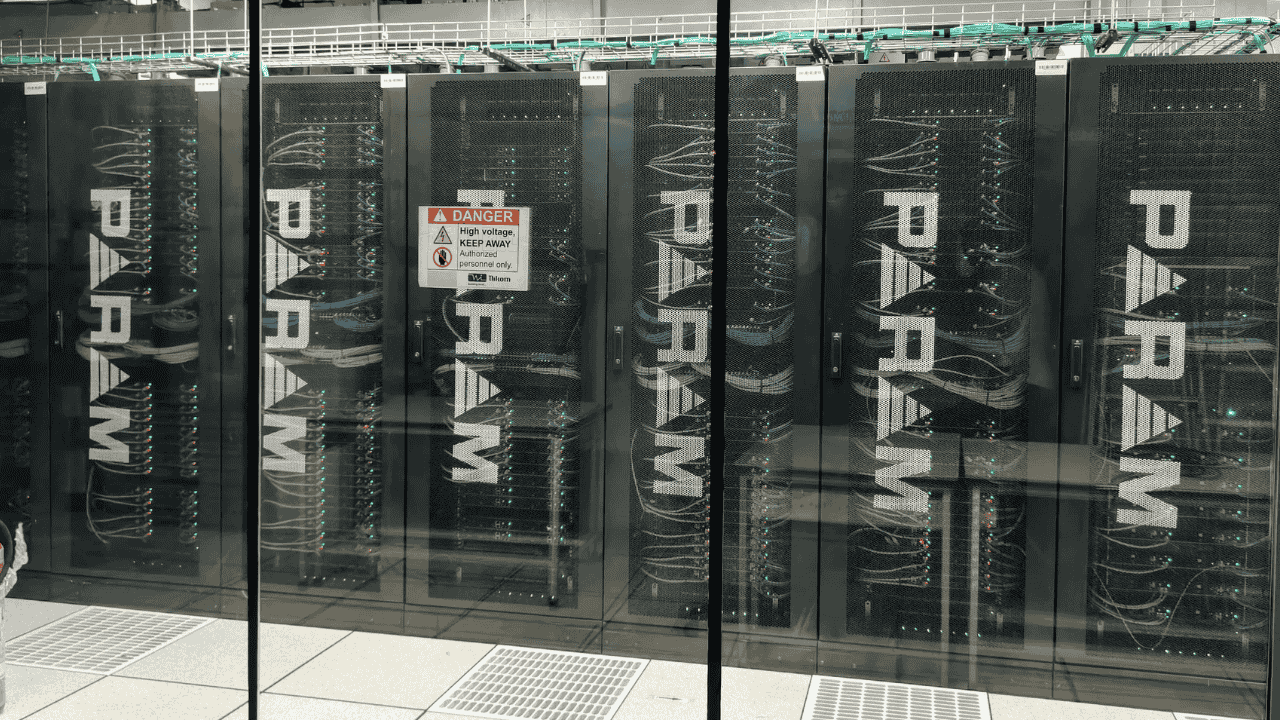
Param Shakti Supercomputer: India's Indigenous Computing Revolution for UPSC Current Affairs
What is Param Shakti? Understanding India's Latest Supercomputing Achievement
On January 3, 2026, India achieved a major technological milestone with the official inauguration of Param Shakti, an indigenous supercomputing facility at the Indian Institute of Technology (IIT) Madras. Inaugurated by S. Krishnan, Secretary of the Ministry of Electronics and Information Technology (MeitY), this facility represents a transformative moment in India's push toward technological self-reliance and Atmanirbhar Bharat (self-reliant India).
Param Shakti is built upon the PARAM RUDRA supercomputing cluster, designed and developed entirely by the Centre for Development of Advanced Computing (C-DAC), Pune. The system operates on open-source software, including AlmaLinux and C-DAC's indigenously developed system software stack, ensuring complete independence from foreign technological dependencies.
Key Specifications: Breaking Down Param Shakti's Computing Power
Computing Capacity and Performance Metrics
Peak Computing Power: 3.1 petaflops (quadrillion floating-point operations per second)
Processing Capacity: Over 3.1 quadrillion calculations per second
Ranking: Among the most powerful computing systems in Indian academic institutions (second only to PARAM Siddhi AI at 5.2 petaflops in C-DAC, Pune)
Operational Status: Fully operational since May 2025 with over 80% utilization rate
Manufacturing: Entirely developed and manufactured within India
Technical Specifications
| Aspect | Details |
|---|---|
| Server Architecture | C-DAC PARAM RUDRA series servers |
| Software Platform | AlmaLinux and indigenously developed system software |
| Storage Infrastructure | Advanced Lustre-based primary storage (1.5 PiB usable) with 50 GB/Sec write throughput |
| Archival Capacity | 500 TiB usable capacity |
| Cooling System | Advanced cooling infrastructure for energy efficiency |
| Power Supply | Uninterrupted electricity supply with optimized energy consumption |
Host Institution
IIT Madras has been selected as the host institution under the National Supercomputing Mission framework, making it the primary research hub for this cutting-edge computational facility.
National Supercomputing Mission (NSM): The Broader Context
Param Shakti is a flagship project under the National Supercomputing Mission (NSM), launched in 2015 as a joint initiative of:
Ministry of Electronics and Information Technology (MeitY)
Department of Science and Technology (DST)
Implementation Partners: C-DAC, Pune and Indian Institute of Science (IISc), Bengaluru
Mission Objectives and Achievements
The NSM aims to establish India's indigenous supercomputing infrastructure while connecting academic and research institutions through the National Knowledge Network (NKN). Key accomplishments include:
37 supercomputers already installed nationwide across IITs, NITs, IISER, and IISc
Completion of Phase 1 supercomputer installations with Param Shakti's inauguration
Planned expansion: Multiple new systems in the pipeline, including a 20-petaflop indigenous supercomputer for Bengaluru
Technological focus: Support for multiple GPU architectures to avoid technological dependence
Research Applications: Transforming Indian Science and Innovation
Param Shakti is designed to accelerate breakthroughs across multiple critical research domains:
Primary Research Areas
Aerospace Engineering
Hypersonic vehicle design and aerodynamic simulations
Flight dynamics modeling and optimization
Climate and Environmental Science
Advanced climate modeling for weather prediction
Large-scale atmospheric and oceanic simulations
Environmental impact assessments
Materials Science and Engineering
Advanced materials research and development
Crystal structure analysis and prediction
Nanotechnology applications
Pharmaceutical and Drug Discovery
Molecular dynamics simulations
Drug-target interaction modeling
Accelerated drug development timelines
Genomics and bioinformatics research
Nuclear Science Research
Nuclear reactor simulations
Particle physics computations
Radiation physics applications
Artificial Intelligence and Machine Learning
Large-scale AI model training
Deep learning algorithm development
Computer vision and natural language processing research
Operational Impact
Since becoming operational in May 2025, Param Shakti has achieved over 80% utilization, indicating strong demand from the research community across multiple departments at IIT Madras and neighboring research institutions.
Indigenous Development: India's Technological Self-Reliance
One of the most significant aspects of Param Shakti is its entirely indigenous design and manufacturing. This achievement carries strategic importance:
Why Indigenous Supercomputing Matters
Technological Sovereignty: Reduces dependence on foreign suppliers for critical computing infrastructure
Cost Efficiency: Eliminates expensive licensing and import costs
Customization: Allows tailoring of systems to specific national research needs
National Security: Ensures sensitive research isn't dependent on external technology ecosystems
Knowledge Transfer: Builds domestic expertise in high-performance computing systems
Future Scalability: Enables rapid expansion of computing infrastructure nationwide
Comparative Context
While PARAM Siddhi AI (5.2 petaflops) currently holds the title of India's most powerful supercomputer, it is built on NVIDIA's global DGX SuperPOD architecture. Param Shakti stands out as the most powerful entirely indigenous supercomputer, underscoring India's progress toward technological autonomy.
National Integration: The Supercomputing Grid
Param Shakti connects with the broader National Knowledge Network (NKN), creating an interconnected grid of 70+ high-performance computing facilities. This networking approach offers several advantages:
Distributed Computing Resources: Researchers across India can access Param Shakti's resources remotely
Collaborative Research: Enables multi-institutional research projects leveraging distributed supercomputing power
Resource Optimization: Efficient allocation of computational resources based on research demands
Regional Development: Strengthens research ecosystems in academic institutions across the country
Strategic Implications: Atmanirbhar Bharat and Digital India
The launch of Param Shakti represents a crucial step in India's broader digital transformation agenda:
Policy Alignment
Atmanirbhar Bharat Initiative: Strengthens India's self-reliance in critical digital infrastructure
Digital India Mission: Advances computational capabilities for the digital economy
IndiaAI Mission: Supports AI research through dedicated supercomputing resources
National Technology Platform: Provides infrastructure for India's scientific and industrial advancement
Global Competitiveness
With 37 supercomputers operational and more planned, India is building a computing infrastructure comparable to leading nations, positioning itself for greater participation in global scientific collaboration.
Why This Matters for Your Exam Preparation
For aspirants preparing for UPSC Civil Services and other competitive examinations, Param Shakti holds significant relevance across multiple dimensions:
General Studies Paper-III (Science and Technology, Economic Development)
Supercomputing and Technological Self-Reliance: Questions frequently test understanding of India's indigenous technology projects. Param Shakti exemplifies India's progress in developing high-tech infrastructure without foreign dependency—a key theme in UPSC examinations.
Atmanirbhar Bharat Mission: The launch directly aligns with government initiatives to promote self-reliance. UPSC often includes questions about flagship government programs and their implementation.
Public Sector Undertakings (PSUs) and Institutional Development: C-DAC's role and the participation of premier institutes like IIT Madras represent important institutional mechanisms for technological advancement—relevant for GS-III and administrative structure questions.
General Studies Paper-II (Governance and Social Development)
Science and Technology Policy: Understanding India's National Supercomputing Mission reflects knowledge of government policy frameworks and strategic planning—crucial for GS-II discussions on governance structures.
Inter-ministerial Collaboration: NSM's joint governance by MeitY and DST demonstrates institutional collaboration, important for understanding government functioning and policy coordination.
Prelims and Mains Examination Strategy
Key Pointers for Memorization:
3.1 petaflops computing capacity
Inaugurated January 3, 2026 at IIT Madras
Developed by C-DAC, Pune
Entirely indigenous and open-source
Part of NSM (37 supercomputers deployed, Phase-1 complete)
Applications: aerospace, climate science, drug discovery, AI research
Potential Question Types:
Fact-based: "What is the computing capacity of Param Shakti?"
Conceptual: "How does indigenous supercomputing strengthen India's technological autonomy?"
Application-based: "Discuss the role of supercomputing infrastructure in India's research ecosystem."
Related Topics for Broader Context
Prepare interconnected topics that often appear alongside supercomputing in UPSC syllabi:
National Supercomputing Mission (NSM): Complete overview of launch, objectives, and implementation
Centre for Development of Advanced Computing (C-DAC): History, mandate, and major projects
High-Performance Computing (HPC) in India: Other significant systems and their applications
Digital Infrastructure in India: 5G, broadband, data centers, and computing networks
International Space Research: Links to ISRO's computational needs (relevant for sci-tech questions)
Climate Science and Research: Connection to India's climate commitments and COP discussions
Pharmaceutical and Defense Research: Industrial applications of supercomputing
Interview (Personality Test) Relevance
If selected for the interview round, knowledge of Param Shakti demonstrates:
Awareness of Current Affairs: Shows engagement with recent national developments
Understanding of Governance: Reflects knowledge of government decision-making and technology policy
National Pride and Vision: Demonstrates familiarity with India's developmental trajectory
Interdisciplinary Knowledge: Links technology, science, governance, and economics
Interview Discussion Points:
"How do you see projects like Param Shakti contributing to India's development?"
"What challenges does India face in achieving complete technological self-reliance?"
"How can indigenous supercomputing support India's climate and healthcare sectors?"
Internal Resources and Related Articles
For comprehensive preparation on related topics, explore these interconnected subjects on Atharva Examwise:
National Technology Initiatives and Indigenous Innovation
Science and Technology Governance in India
Public Sector Undertakings and Institutional Frameworks
Climate Change and Environmental Research Infrastructure
Digital Infrastructure and National Security
India's Position in Global Technology Rankings
Conclusion: A Milestone in India's Scientific Journey
Param Shakti represents far more than just another supercomputer—it symbolizes India's transition from a technology consumer to a technology creator. By developing indigenous supercomputing capacity, India is:
Reducing strategic technological dependence
Building domestic expertise in critical domains
Accelerating research across vital sectors
Creating a foundation for future innovation
Demonstrating commitment to Atmanirbhar Bharat
For UPSC aspirants, understanding Param Shakti's significance, specifications, and implications provides valuable insights into India's contemporary technological trajectory—a crucial component of modern General Studies preparation. Stay updated with developments in this space, as supercomputing infrastructure will likely feature in future UPSC examinations as India progresses toward becoming a technological superpower.