
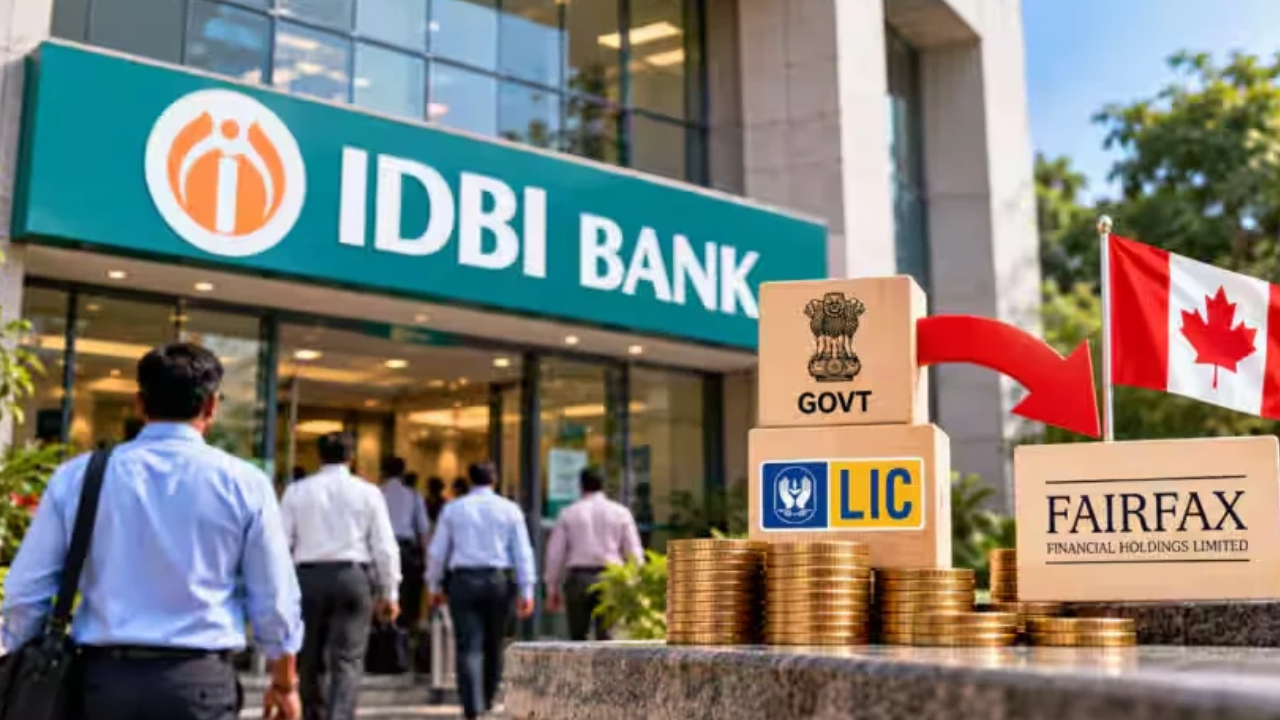
UPSC Current Affairs October 15, 2026: CCEA Approves ₹52,878 Crore IDBI Bank Strategic Restructuring & Fairfax FDI Deal | Atharva Examwise Daily GK Update
Executive Summary: India's Largest Financial Sector FDI
In a landmark macroeconomic reform dominating current affairs October 15, 2026, the Cabinet Committee on Economic Affairs (CCEA), chaired by Prime Minister Narendra Modi, approved the strategic restructuring and majority stake sale of IDBI Bank Ltd. to Canada-based Fairfax Financial Holdings Ltd.. Valued at ₹52,878.08 crore (approximately $5.5 billion) at a winning bid of ₹81 per share, the transaction represents the single largest Foreign Direct Investment (FDI) in the history of India's financial sector and the largest strategic privatization exercise since the sale of Air India in 2021–22.
For civil services aspirants tracking UPSC current affairs and competitive exam news today, this transaction marks a structural inflection point in Indian banking governance. Under the approved framework, the Government of India (GoI) will divest 30.48% of its equity and the Life Insurance Corporation of India (LIC) will offload 30.24%, transferring an aggregate 60.72% controlling stake along with management control to Fairfax's wholly owned subsidiary, M/s 10955230 Canada Inc.. Post-transaction, the Centre and LIC will retain residual stakes of 15% and 19% respectively—totalling 34%—while completely withdrawing their nominee directors from the bank's Board of Directors and reclassifying themselves as public shareholders.
This Atharva Examwise current news and daily GK update provides an exhaustive, exam-oriented analysis of the IDBI Bank restructuring, dissecting the two-stage valuation methodology, Reserve Bank of India (RBI) regulatory conditionalities, Prompt Corrective Action (PCA) turnaround metrics, and fiscal implications for the Union Budget 2026–27. Aspirants can integrate this analysis with the Atharva Examwise Daily Current Affairs Portal and foundational macroeconomics modules available on the NCERT Economics & Study Material Hub.
Key Facts and Exam-Relevant Data
Competitive examinations such as UPSC CSE Prelims, RBI Grade B, SBI/IBPS PO, and State PCS and MPPSC Examinations frequently test granular institutional, regulatory, and numerical parameters of major disinvestment deals. The core factual takeaways from the official Press Information Bureau (PIB) CCEA Release and the Ministry of Finance Official FAQs are summarized below:
Approving Authority and Date: Cabinet Committee on Economic Affairs (CCEA), approved on October 14, 2026.
Nodal Implementing Agency: Department of Investment and Public Asset Management (DIPAM), Ministry of Finance, headed by DIPAM Secretary Arunish Chawla.
Approved Strategic Buyer: M/s 10955230 Canada Inc., a special purpose vehicle of parent entity M/s Fairfax Financial Holdings Ltd. (headquartered in Toronto, Canada, and founded by Indian-origin billionaire Prem Watsa).
Total Quantum of Stake Sold: 60.72% of total paid-up equity (comprising 30.48% held by the Government of India and 30.24% held by LIC).
Total Purchase Consideration: ₹52,878.08 crore (exact official figure: ₹52,878.0806181 crore), divided between the Centre (~₹26,539 crore) and LIC (~₹26,339 crore) in exact proportion to the equity offloaded.
Winning Bid vs. Benchmark Price: Fairfax's best offer bid of ₹81.00 per share exceeded the official benchmark fair valuation of ₹75.99 per share determined by two independent valuation agencies.
Post-Deal Residual Shareholding: Combined 34.00% retained as public shareholding without board representation (15.00% with GoI and 19.00% with LIC).
Three-Tier Institutional Mechanism: The bidding and evaluation process was supervised by an Inter-Ministerial Group (IMG), the Core Group of Secretaries on Disinvestment (CGD), and an Alternative Mechanism (AM) comprising an empowered Group of Cabinet Ministers.
Regulatory and Operational Lock-Ins: The strategic buyer faces a 3-year lock-in on invested capital, a 5-year promoter lock-in, must preserve the IDBI Bank brand name and identity for at least 3 years, and has up to 15 years to align promoter shareholding with RBI's 26% cap.
Cross-Holding Mandate (CSB Bank Rule): Because Fairfax already holds a 40% stake in Kerala-based CSB Bank, RBI's single-promoter rule mandates that Fairfax must either merge CSB Bank with IDBI Bank or divest its CSB Bank stake within 2 years of executing the Share Purchase Agreement (SPA).
| Parameter / Metric | Pre-Restructuring Status | Transaction Action / Mandate | Post-Restructuring Status |
|---|---|---|---|
| Government of India (GoI) Equity | 45.48% (Co-Promoter) | Divests 30.48% stake (~₹26,539 Cr inflow) | 15.00% (Public Shareholder; zero Board seats) |
| LIC of India Equity | 49.24% (Co-Promoter with Management Control) | Divests 30.24% stake (~₹26,339 Cr inflow) | 19.00% (Public Shareholder; must trim to 15% in 2 yrs) |
| Strategic Buyer (Fairfax / Canada Inc.) | 0.00% | Acquires 60.72% stake for ₹52,878.08 Cr + Open Offer | 60.72% (Promoter with Management Control) |
| Public / Minority Shareholders | 5.28% | Entitled to participate in Fairfax's mandatory Open Offer | 5.28% (Prior to Open Offer adjustments) |
| Board Representation (GoI & LIC) | Nominee Directors on Board | Complete withdrawal of all nominee directors | Nil (Independent private board governance) |
| Capital Adequacy Ratio (CAR) | 6.22% (Crisis low in FY18) | Rebounded to 26.65% by March 2026 pre-sale | Bolstered by private capital & zero fiscal reliance |
Structural Anatomy of the IDBI Bank–Fairfax Transaction
A critical nuance highlighted by Union Finance Minister Nirmala Sitharaman is the official characterization of this deal as a "Strategic Restructuring" rather than a conventional termination of state interest. By retaining a combined 34% residual equity while surrendering promoter status and board representation, the state and LIC transition from active managerial guarantors to passive financial investors. This architecture allows the public exchequer and millions of LIC policyholders to capture future capital appreciation driven by private managerial efficiency without bearing the moral hazard of recurrent taxpayer-funded bailouts. Furthermore, LIC recovers nearly its entire January 2019 capital infusion from the partial stake sale alone while retaining significant upside in the restructured institution.
Historical Trajectory: From Industrial Development Bank to PCA and Turnaround
To comprehend the structural necessity of this transaction for UPSC Mains GS Paper III, candidates must trace IDBI Bank's institutional evolution. Originally established in 1964 as the Industrial Development Bank of India—a statutory Development Financial Institution (DFI) spearheading industrial credit—the entity was converted into a commercial banking company in 2004. However, aggressive corporate infrastructure lending during the 2008–2014 credit boom saddled the bank with severe Non-Performing Assets (NPAs), including high-profile defaults such as Kingfisher Airlines and ABG Shipyard.
As gross NPAs surged and capital buffers eroded—driving its Capital Adequacy Ratio (CAR) down to a precarious 6.22% in 2018—the Reserve Bank of India placed IDBI Bank under the Prompt Corrective Action (PCA) Framework on May 5, 2017. The PCA regime imposed stringent operational curbs on branch expansion, dividend distribution, and high-risk corporate lending. To avert systemic contagion without exhausting budgetary capital, the Union Government facilitated LIC's acquisition of a controlling 51% stake in January 2019, prompting the RBI to reclassify IDBI Bank as a private sector bank for regulatory purposes.
Demonstrating a remarkable balance-sheet cleanup over the subsequent seven years, IDBI Bank's financial indicators recovered sharply. Recognizing sustained improvements in asset quality and capital adequacy, the RBI lifted PCA restrictions on March 10, 2021, subject to continuous regulatory monitoring. By March 2026, IDBI Bank's Capital Adequacy Ratio rebounded to a robust 26.65%, and the lender recorded an all-time high net profit of ₹9,513 crore in FY 2025–26. This operational turnaround allowed LIC to realize substantial returns on its rescue capital. Having infused ₹26,867 crore in January 2019 at an average acquisition price of ₹60.73 per share, LIC's sale of a 30.24% tranche at ₹81.00 per share locks in a 33.4% (nearly 33.5%) capital gain per share, generating approximately ₹26,300 crore in cash while leaving the insurer with a 19% equity stake worth over ₹16,500 crore at the acquisition price.
Institutional Architecture and Valuation Methodology
A major analytical focus of the official PIB release is the transparent explanation of why the government disregarded prevailing stock market prices during the second round of bidding—an essential case study in public finance and administrative governance.
The Two-Round Bidding Process and the Low-Float Volatility Problem
The government initiated the strategic sale on October 7, 2022, by issuing the Preliminary Information Memorandum (PIM) to invite Expressions of Interest (EoI). Out of five entities that submitted EoIs, four cleared the RBI's stringent 'Fit and Proper' assessment and Ministry of Home Affairs (MHA) security clearances, and two qualified bidders ultimately submitted techno-financial bids.
However, the first round of financial bidding in FY 2025–26 encountered a structural market distortion. Because GoI (45.48%) and LIC (49.24%) held 94.72% of IDBI Bank's equity, only 5.28% of the stock was available for public trading in the secondary market. Speculative trading in this extremely narrow public float drove the stock price from its unimpacted pre-EoI level of ₹42.40 per share (on October 6, 2022) to an artificially impacted high of ₹108.12 per share on January 8, 2026—the day before initial bids were invited. Anchored to these elevated market prices, the government's initial reserve price was fixed at ₹94.42 per share. Both qualified bidders submitted bids below this threshold, leading the government to reject the initial round. Once the market learned that the initial bids had failed, the speculative premium evaporated, and IDBI Bank's stock corrected sharply below ₹75 per share, settling at ₹70.38 per share on May 18, 2026, just prior to the invitation of second-round "Best Offer Bids".
| Valuation & Bidding Milestone | Reference Date | Price (₹ / Share) | Strategic & Regulatory Significance |
|---|---|---|---|
| Unimpacted Pre-EoI Stock Price | October 6, 2022 | ₹42.40 | Baseline market price prior to issuance of the Preliminary Information Memorandum on October 7, 2022. |
| Round 1 Pre-Bid Impacted Price | January 8, 2026 | ₹108.12 | Speculative surge in the narrow 5.28% public float ahead of initial bid invitations. |
| Round 1 Reserve Price (Rejected) | FY 2025–26 | ₹94.42 | Initial reserve price anchored to impacted market prices; initial bids fell short and were rejected. |
| Round 2 Pre-Invitation Market Price | May 18, 2026 | ₹70.38 | Market price after speculative premium corrected below the Round 1 discovered bid price of ₹75.00. |
| Valuation Period Volatility Range | FY23 – FY27 | ₹61.01 – ₹118.38 | Extreme high-low trading range prompting DIPAM to disregard secondary market prices in Round 2. |
| Independent Benchmark Valuation | March 31, 2026 (Accounts) | ₹75.99 | Average of Market Multiple Method and Asset Valuation Method by two independent agencies. |
| Fairfax Winning Best Offer Bid | October 14, 2026 | ₹81.00 | Approved CCEA acquisition price; exceeds ₹75.99 benchmark and both independent agency estimates. |
| Post-Announcement Market Adjustment | October 14–15, 2026 | ₹90.44 to ₹83.62 | BSE stock closed at ₹90.44 pre-announcement on Oct 14 and adjusted 7.54% to ₹83.62 on Oct 15 toward the deal price. |
Dual Independent Valuation Methodologies
Recognizing that a thinly traded stock (which fluctuated wildly between ₹61.01 and ₹118.38 per share during the valuation period) misrepresented intrinsic enterprise value, DIPAM engaged two independent professional valuation agencies to evaluate IDBI Bank based on its audited accounts as of March 31, 2026, using two complementary methodologies. Under the Relative Valuation by Market Multiple Method, the agencies evaluated IDBI Bank's fair market value by benchmarking its financial ratios and closing accounts against peer Public Sector Banks (PSBs) as of March 31, 2026. Concurrently, under the Asset Valuation Method, the agencies determined the enterprise's Fair Net Asset Value by assessing all tangible and intangible assets—including land, commercial properties, and brand equity—net of total liabilities as of March 31, 2026.
The average of the two independent valuations established an official benchmark price of ₹75.99 per share. Fairfax's best offer bid of ₹81.00 per share surpassed both the ₹75.99 benchmark and the individual fair value estimates of both agencies, while representing a 15.1% premium over the ₹70.38 market price prevailing prior to the second-round invitation. Following the announcement on October 14, 2026, secondary market prices adjusted downward by 7.54% on the BSE from ₹90.44 to ₹83.62 per share on October 15, converging toward the ₹81 acquisition and open-offer anchor.
Regulatory Conditionalities and Banking Sector Consolidation
Because banking licenses in India are subject to strict prudential oversight by the Reserve Bank of India under the Banking Regulation Act, 1949, the CCEA approval is accompanied by rigorous post-approval regulatory mandates. Prior to final transaction closure, Fairfax must present its credentials to the RBI under the 'Fit and Proper' assessment and submit a binding roadmap for regulatory compliance.
| Stakeholder / Dimension | Regulatory Mandate / Conditionality | Statutory / Timeline Requirement |
|---|---|---|
| Fairfax Financial Holdings (Promoter Cap) | Must comply with RBI's Master Direction on Ownership in Private Sector Banks, which caps long-term promoter voting equity at 26%. | Granted a 15-year glide path to reduce stake from 60.72% to 26%, with a 5-year promoter lock-in (and 3-year capital lock-in). |
| Fairfax Cross-Holding in CSB Bank | RBI norms prohibit a single entity from acting as promoter of two scheduled commercial banks simultaneously; Fairfax currently holds 40% in Kerala-based CSB Bank. | Must either merge CSB Bank into IDBI Bank or divest its CSB Bank stake within 2 years of executing the Share Purchase Agreement. |
| Minority Shareholders (Open Offer) | SEBI (Substantial Acquisition of Shares and Takeovers) Regulations require an acquirer taking control of a listed entity to offer an exit to retail/minority holders. | Mandatory Open Offer to public shareholders by Fairfax prior to transaction closure. |
| LIC of India (Residual Equity) | RBI norms restrict a non-promoter financial institution's long-term shareholding in a private bank to 15%. | LIC must reduce its residual stake from 19% to 15% within 2 years. |
| Government of India (Residual Equity) | CCEA empowered the Alternative Mechanism (AM) to manage future dilution of the Centre's 15% residual holding. | Open market minority stake sales as per standard operating procedures. |
| Brand Identity & Employees | Continuity of institutional identity and protection of human capital during transition. | No change in IDBI Bank name or brand for 3 years; separate pension fund established for former employees. |
Second-Order Impact: Potential Merger of CSB Bank and MSME Credit Expansion
The single-promoter mandate creates a compelling second-order consolidation catalyst in Indian banking. Fairfax Financial Holdings is already deeply embedded in India's financial ecosystem, holding a 40% controlling stake in CSB Bank (formerly Catholic Syrian Bank), a 14% stake in IIFL, and roughly 57% in Go Digit General Insurance. If Fairfax elects to merge CSB Bank with IDBI Bank within the stipulated two-year window, the combined entity will synergize CSB Bank's strong regional retail franchise with IDBI Bank's pan-India branch network and corporate balance sheet. For existing retail customers and depositors, banking operations, deposit accounts, and loan agreements will continue seamlessly, while operational efficiency is projected to improve through private capital infusion and modern banking technology. Furthermore, as Union Minister Ashwini Vaishnaw emphasized during the Cabinet briefing, the entry of long-term foreign patient capital and global risk-management practices will significantly expand credit availability for Micro, Small, and Medium Enterprises (MSMEs) without straining sovereign fiscal resources.
Macroeconomic and Fiscal Implications for FY 2026–27
From a public finance perspective, the IDBI Bank transaction revitalizes India's disinvestment programme at a critical geopolitical juncture. Since FY 2010–11, the Union Government has surpassed its annual budgetary disinvestment target only twice—in FY18 (crossing ₹1 lakh crore) and FY19 (raising ₹94,727 crore against an ₹80,000 crore target). Between FY20 and FY25, strategic sales slowed considerably, with disinvestment proceeds dropping to a low of ₹10,163 crore in FY25.
For FY 2026–27, the Union Budget set a combined target of ₹80,000 crore under miscellaneous capital receipts (encompassing disinvestment and asset monetisation) alongside a fiscal deficit target of 4.3% of GDP. With DIPAM Secretary Arunish Chawla confirming that the Share Purchase Agreement (SPA) will be executed and the transaction completed before the end of the current financial year (FY27), the Centre's 30.48% stake sale alone will generate over ₹26,000 crore (~₹26,539 crore) in non-debt capital receipts. Combined with existing disinvestment and PSU dividend receipts already reaching ₹79,896.84 crore, the IDBI windfall will lift total realisations past ₹88,000 crore to over ₹1 lakh crore—marking the first time since FY19 that the government beats its disinvestment target. This fiscal cushion provides vital counter-cyclical breathing room to sustain public capital expenditure amid West Asian geopolitical disruptions and global economic uncertainties.
Why this matters for your exam preparation
For serious aspirants preparing with Atharva Examwise, the IDBI Bank–Fairfax deal is a high-yield topic that bridges static economic concepts from the NCERT Foundation Course with dynamic policy analysis across multiple competitive exam stages. In UPSC CSE Prelims and State PCS (such as MPPSC) Prelims, examiners frequently test the conceptual distinction between token disinvestment (where the government sells a minor equity tranche while retaining over 51% ownership and management control), strategic disinvestment (involving the transfer of both substantial shareholding and management control to a private entity), and strategic restructuring. The IDBI Bank transaction exemplifies strategic restructuring because the state and LIC fully exit board governance and promoter status while retaining a passive 34% minority stake to capture future equity appreciation. Prelims candidates must also note that the government's ₹26,539 crore proceeds are accounted for in the Union Budget as Non-Debt Capital Receipts (NDCR), which help finance the fiscal deficit (targeted at 4.3% of GDP in FY27) without creating future debt-servicing obligations. Additionally, regulatory questions can be framed around the RBI's Prompt Corrective Action (PCA) framework, the 'Fit and Proper' assessment for bank promoters, the 15% cap on non-promoter institutional holdings (requiring LIC to pare its stake from 19% to 15% within two years), and the 15-year glide path granted to promoters to align with the 26% voting equity cap.
For UPSC CSE Mains under General Studies Paper III (Indian Economy, Government Budgeting, and Banking Sector Reforms), the transaction offers a comprehensive case study on value-maximizing public asset management. Rather than conducting a distress sale when IDBI Bank was burdened by corporate NPAs and a 6.22% Capital Adequacy Ratio under the 2017 PCA regime, the government and LIC first stabilized and cleaned up the lender's balance sheet, enabling it to exit PCA in March 2021 and achieve a 26.65% CAR and ₹9,513 crore net profit by FY 2025–26. This sequenced reform ensured that privatization occurred from a position of financial strength, attracting India's largest-ever financial sector FDI of ₹52,878.08 crore. Moreover, DIPAM's decision in the second round of bidding to replace speculative, low-float secondary market prices with dual independent fundamental valuations (combining the Market Multiple Method and Asset Valuation Method to arrive at the ₹75.99 benchmark) provides an exemplary governance model for pricing public assets transparently. Aspirants preparing for Mains answer writing should practice evaluating how this restructuring shifts the banking paradigm from taxpayer-funded bailouts to private capital-driven MSME credit growth, and can access daily practice MCQs, mind maps, and Union Budget 2026–27 revision notes on the Atharva Examwise Study Material & PYQ Portal.