
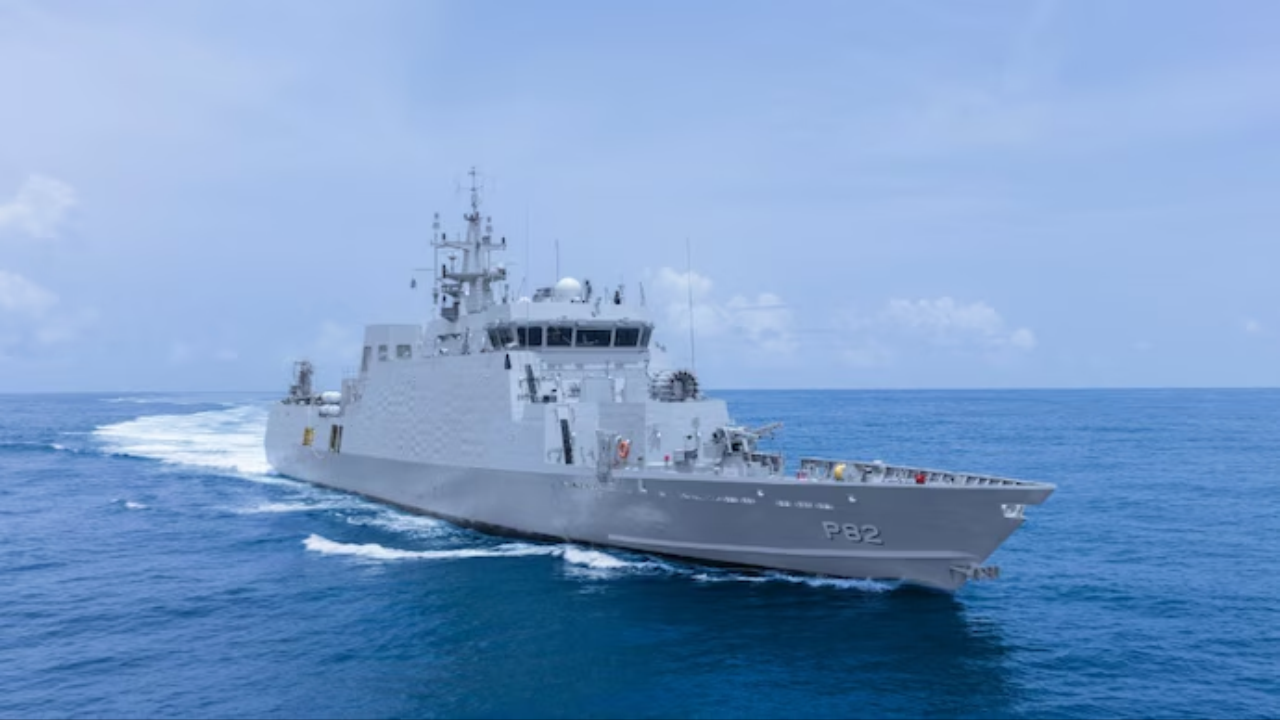
UPSC Current Affairs October 15, 2026: Indian Navy Commissions INS Mangrol (P82) | Atharva Examwise Current News, Daily GK Update & Competitive Exam News Today
Executive Summary: Commissioning of INS Mangrol (P82)
On October 12, 2026, the Indian Navy formally commissioned INS Mangrol (P82), the third vessel of the indigenous Mahe-class Anti-Submarine Warfare Shallow Water Craft (ASW-SWC), at the Naval Dockyard in Mumbai. Presided over by Vice Admiral Sanjay Vatsayan, Flag Officer Commanding-in-Chief (FOC-in-C) of the Western Naval Command, the ceremony was attended by senior officers of the Defence Forces, representatives from the Ministry of Defence, executives from Cochin Shipyard Limited (CSL), and domestic defence industry partners. This induction marks a decisive operational milestone in securing India's littoral waters and continental shelf approaches against sub-surface proliferation in the Indian Ocean Region.
Indigenously designed and constructed by Cochin Shipyard Limited (CSL), Kochi, the warship incorporates over 80% indigenous content, exemplifying the maturation of India's domestic defence industrial base under the Aatmanirbhar Bharat and Make in India frameworks. For civil services aspirants tracking UPSC current affairs, daily GK updates, and competitive exam news today on Atharva Examwise Current Affairs, the induction of INS Mangrol represents a critical convergence of maritime security doctrine, indigenous defence manufacturing, and littoral warfare modernization.
Key Facts and Exam-Relevant Data
To facilitate rapid recall across Preliminary and one-day examinations (UPSC CSE, CDS, CAPF, MPPSC, and State PCS), the essential factual parameters and exam-relevant data of the commissioning are highlighted below:
Vessel Name and Identification: INS Mangrol (Pennant Number P82), constructed under Yard Number 525 (also designated BY 524 during keel laying) at a unit cost of ₹789 crore (US$82 million in FY2020).
Vessel Class and Project Series: Third warship of the Mahe-class Anti-Submarine Warfare Shallow Water Craft (ASW-SWC), following the earlier inductions of INS Mahe (P80) and INS Malvan.
Commissioning Date and Venue: Formally inducted on October 12, 2026, at the Naval Dockyard, Mumbai, following its delivery to the Indian Navy on August 21, 2026.
Presiding Authority: Vice Admiral Sanjay Vatsayan, Flag Officer Commanding-in-Chief, Western Naval Command.
Shipbuilder and Construction Milestones: Ordered on April 30, 2019, from Cochin Shipyard Limited (CSL), Kochi; its keel was laid on February 21, 2023, and it was launched simultaneously alongside Mahe and Malvan on November 30, 2023.
Indigenous Content and Domestic Supply Chain: Features over 80% indigenous content, drawing heavily on Indian defence firms including Bharat Electronics Limited (BEL), Mahindra Defence, Larsen & Toubro (L&T), DRDO, and numerous Micro, Small, and Medium Enterprises (MSMEs).
Etymology and Geographical Significance: Named after the historical coastal town and prominent marine fishing harbour of Mangrol in the Junagadh district of Gujarat.
Historical Naval Legacy: Carries forward the operational heritage of the erstwhile INS Mangrol (M85), a minesweeper that served the Indian Navy from 1983 until April 7, 2004.
Emblem and Tactical Motif: Displays a five-pointed weapon (Panjmukh) on its crest, while the Indian Navy compares its operational strike accuracy to the Pied Kingfisher ("Like a Pied Kingfisher, we strike with precision"), a black-and-white waterbird native to the Mangrol coast renowned for its hovering flight and high-precision diving strikes in shallow water.
Propulsion Distinction: Driven by three diesel engine-powered waterjet propulsion units, making the Mahe class the largest class of waterjet-propelled warships in the Indian Navy.
Technical Architecture and Combat Capabilities of INS Mangrol
The operational mandate of INS Mangrol centers on bridging a critical tactical gap in India's maritime security architecture: the detection, tracking, and neutralization of underwater threats within shallow coastal waters and littoral zones. While capital surface combatants such as destroyers and stealth frigates excel in deep-water anti-submarine warfare, their deep drafts and wide turning circles impose severe operational limitations in shallow continental shelves, harbour approaches, and confined coastal channels.
To overcome these physical constraints, INS Mangrol is engineered with an exceptionally shallow draft of 2.7 meters (8 ft 10 in), an overall length of 78 meters, a beam of 11.26 to 11.36 meters, and a displacement between 896 and 1,100 tonnes. Replacing conventional exposed propeller shafts with three diesel engine-driven waterjet propulsion units, the vessel achieves a maximum speed of 25 knots (46 km/h) and an operational range of 1,800 nautical miles (3,300 km) at a cruising speed of 14 knots, sustaining a 14-day mission endurance with a complement of 57 personnel (7 officers and 50 sailors) and carrying one Rigid Hull Inflatable Boat (RHIB). Waterjet propulsion not only reduces draft requirements and eliminates appendage drag, but also enhances rapid response and agility when prosecuting elusive sub-surface contacts in confined waters.
| Parameter Category | Technical Specification / System Installed | Operational Role & Tactical Advantage |
|---|---|---|
| Vessel Classification | Mahe-Class ASW Shallow Water Craft (P82 / Yard 525) | Coastal anti-submarine warfare, LIMO, and mine warfare tasks |
| Builder & Origin | Cochin Shipyard Limited (CSL), Kochi (>80% Indigenous) | Domestic warship design, construction, and systems integration |
| Dimensions & Tonnage | Displacement: 896–1,100 t; Length: 78 m; Beam: 11.26 m; Draft: 2.7 m | Unrestricted operation in shallow coastal approaches where larger ships face limits |
| Propulsion & Mobility | 3 × Diesel engine-driven waterjet propulsion units; Max Speed: 25 knots | Largest waterjet-powered vessel class in the Indian Navy; rapid littoral manoeuvrability |
| Range & Endurance | 1,800 nmi (3,300 km) at 14 knots; 14-day endurance; 57 crew | Sustained coastal patrolling and maritime domain awareness |
| Primary Sonar Suite | DRDO Abhay Hull-Mounted Sonar (HMS) & Low Frequency Variable Depth Sonar (LFVDS) | Sub-surface acoustic detection and tracking in reverberant littoral environments |
| ASW Weapons | 1 × Indigenous Anti-Submarine Rocket Launcher (RBU-6000 class), 2 × Triple ALWT Launchers, Anti-Submarine Mines | Multi-layered kinetic engagement of submerged targets and sea denial via mine-laying rails |
| Countermeasure System | Mareech Advanced Torpedo Decoy System | Acoustic deception and soft-kill evasion against incoming adversary torpedoes |
| Surface Guns & C2 | 1 × 30 mm Naval Surface Gun; 2 × OFT 12.7 mm M2 SRCG; IAC Mod 'C' ASW Combat Suite | Low-Intensity Maritime Operations (LIMO), surface self-defence, and automated fire control |
Sensor-to-Shooter Integration in Littoral Environments
Littoral waters represent an exceptionally complex acoustic environment due to shallow-water reverberation, temperature gradients, and high ambient noise from coastal shipping. To ensure reliable underwater surveillance, INS Mangrol is outfitted with a dual-sonar suite comprising the DRDO-developed Abhay Hull-Mounted Sonar (HMS) and a Low Frequency Variable Depth Sonar (LFVDS). Acoustic data from these sensors is synthesized by the ASW Combat Suite (IAC Mod 'C') and an integrated Fire Control System (FCS), enabling the crew to classify and track quiet diesel-electric submarines, midget submarines, and unmanned underwater vehicles operating near Indian harbours.
Once a sub-surface threat is localized, INS Mangrol prosecutes the contact using an indigenous anti-submarine rocket launcher (RBU-6000 class) for area saturation and two triple lightweight torpedo launchers armed with Advanced Light-Weight Torpedoes (ALWT) for high-precision underwater strikes. The warship is additionally equipped with mine-laying rails to deploy anti-submarine mines along tactical choke points, while the Mareech Advanced Torpedo Decoy System provides soft-kill countermeasure protection against incoming acoustic homing torpedoes. For Low-Intensity Maritime Operations (LIMO) and surface self-defence, the vessel mounts a 30 mm Naval Surface Gun as its primary gun alongside two Ordnance Factory Tiruchirappalli (OFT) 12.7 mm M2 Stabilized Remote Controlled Guns (SRCG), which are Indian variants of Elbit Systems' Remote Controlled Naval Weapon Station. Shipboard machinery and survivability functions are highly automated through an Integrated Platform Management System (IPMS) and an Automatic Power Management System (APMS).
Strategic Analysis: Littoral Deterrence and Shipbuilding Modernization
Evaluating the commissioning of INS Mangrol for UPSC Mains GS Paper-III (Internal Security and Defence Indigenization) and GS Paper-II (International Relations and Indian Ocean Geopolitics) reveals deeper structural shifts in India's naval force planning. INS Mangrol belongs to a broader 16-ship ASW-SWC acquisition program initiated in April 2019 to replace legacy Soviet-era Abhay-class corvettes, with construction split between Cochin Shipyard Limited (building the Mahe class) and Garden Reach Shipbuilders & Engineers (GRSE) in Kolkata (building the sister Arnala class, which includes vessels such as Anjadip). The simultaneous launch of Mahe, Malvan, and Mangrol at Kochi in November 2023, followed by Mangrol's rapid transition from delivery in August 2026 to commissioning in October 2026, illustrates the industrial efficiency of modular batch shipbuilding. With the final hull of the 16-vessel project scheduled for delivery by June 2028, India is institutionalizing a robust domestic supply chain linking public shipyards with private defence primes and MSMEs.
From an operational perspective, the induction of specialized shallow-water crafts acts as a strategic force multiplier across the Indian Ocean Region. Without dedicated littoral submarine hunters, the Indian Navy would be compelled to commit high-value blue-water destroyers and frigates to defensive patrols outside major ports, harbours, and coastal energy installations. By assigning Mahe-class corvettes to sanitize coastal approaches in coordination with maritime patrol aircraft, ASW helicopters, coastal radar networks, and underwater sensors, the Navy establishes a layered, largely indigenous anti-submarine shield while freeing larger surface combatants for blue-water power projection.
Furthermore, the commissioning of INS Mangrol reflects an accelerated fleet rejuvenation trajectory across the Indian Navy. Addressing the ceremony in Mumbai, Vice Admiral Sanjay Vatsayan noted that ten warships had already been commissioned in 2026, with another eight scheduled for commissioning shortly—a pace underscored by the launch of the Next Generation Offshore Patrol Vessel Shreyas (Yard 3040) at GRSE on October 10, 2026, and the scheduled commissioning of the indigenous multi-purpose vessel Samarthak on October 16, 2026. This production momentum directly supports the Navy's strategic benchmark: by 2034, approximately 60% of the Indian Navy's platforms are projected to have an average age of less than ten years. Maintaining a young, technologically standardized, and domestically supported fleet ensures superior combat readiness and insulates India's maritime security apparatus from external supply-chain vulnerabilities.
Syllabus Mapping and Related Study Resources on Atharva Examwise
To maximize conceptual retention, aspirants should integrate this daily GK update with foundational subjects and parallel national developments analyzed on Atharva Examwise. Within Science, Technology, and Defence (GS Paper-III), the indigenous sensor integration aboard INS Mangrol parallels India's expanding autonomous capabilities in space-based surveillance and astrophysics, which aspirants can explore in our detailed analyses of UPSC Current Affairs: ISRO Launches EOS-05 via GSLV-F17 and UPSC Current Affairs Today: ISRO Aditya-L1 Solves Solar Coronal Heating Paradox. Similarly, because the >80% indigenous content of INS Mangrol relies extensively on domestic MSME manufacturing networks, students should link this defence milestone with recent economic policy reforms covered in UPSC Current Affairs: Rajya Sabha Passes MSME Development (Amendment) Bill 2026.
For Indian Geography (GS Paper-I), the naming of INS Mangrol after the fishing harbour in Gujarat's Junagadh district highlights the physical geography of the Kathiawar peninsula and India's wide western continental shelf, a foundational topic taught from basic to advanced levels in the Atharva Examwise NCERT Geography Foundation Course (Class 6–12). Aspirants preparing for upcoming Preliminary and Mains cycles can also access monthly current affairs MCQ PDFs, topic-wise mind maps, and previous year question (PYQ) analyses at the Atharva Examwise Study Material Portal, or enroll in structured civil services programs through our MPPSC Live Batch (Pre + Mains) and State PCS Coaching Platform. For primary government documentation, candidates should additionally consult the Press Information Bureau (PIB) Official Release on INS Mangrol (PRID 2322494) and DD News Official Coverage.
Why this matters for your exam preparation
The induction of INS Mangrol (P82) holds direct, multi-dimensional relevance across all stages of the UPSC Civil Services Examination (CSE), CDS, NDA, CAPF (AC), and State Civil Services (MPPSC, UPPCS, BPSC) examinations. In Preliminary examinations, question setters frequently construct statement-based and matching questions around newly inducted naval platforms, testing whether candidates can accurately pair a warship with its class (Mahe-class ASW-SWC), its builder (Cochin Shipyard Limited, Kochi), and its propulsion characteristics (waterjet propulsion). Equally important for Prelims are the indigenous sub-systems aboard INS Mangrol—specifically the Abhay hull-mounted sonar and the Mareech advanced torpedo decoy system—which frequently appear in Science and Technology prompts asking candidates to identify DRDO-developed naval systems. Furthermore, the vessel's namesake links defence current affairs with static coastal geography (Mangrol port in Junagadh district, Gujarat) and avian ecology (the coastal hunting behaviour of the Pied Kingfisher).
For UPSC Mains (GS Paper-III), INS Mangrol provides a high-impact empirical case study under two core syllabus themes: "Indigenization of technology and developing new technology" and "Security challenges and their management in border areas — coastal security". When answering Mains questions on defence indigenization, citing INS Mangrol's over 80% indigenous content, its collaborative supply chain involving BEL, L&T, Mahindra Defence, and domestic MSMEs, and the 16-ship ASW-SWC replacement roadmap finishing in June 2028 substantiates arguments with precise, current evidence. In essays, internal security answers, and UPSC Personality Tests (Interviews) or SSB Interviews, referencing how shallow-water crafts conduct Low-Intensity Maritime Operations (LIMO) to protect ports while advancing the Navy's 2034 modernization vision (ensuring 60% of naval platforms are under ten years of age) demonstrates an authoritative, strategic grasp of India's evolving maritime security doctrine in the Indian Ocean Region